


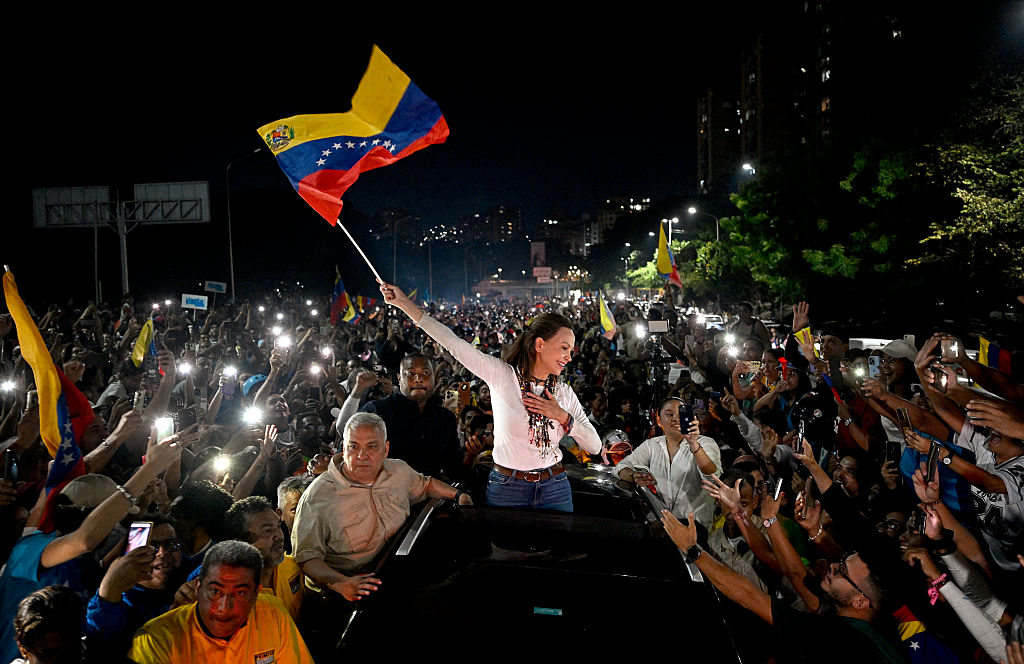
In a surprise move, María Corina Machado, Venezuela’s most popular political leader, returned to her country on October 25, reigniting expectations of a democratic transition and the possibility of early elections, as the U.S. exerts unprecedented control over the nation since capturing and removing Nicolás Maduro from power in January.
After almost 11 months outside Venezuela, Machado reappeared in the central city of Barquisimeto and posted on X: “I am here. With you all,” after entering the country from Colombia. She had made several unsuccessful attempts to return to Venezuela after the twin earthquakes that struck the country on June 24, and last month she was repeatedly denied entry.
U.S. Secretary of State Marco Rubio said on Sunday that the conditions that allowed for Machado’s return were “the direct result of the U.S. supported reconciliation talks.” In comments published on X, the official said: “We expect all political actors to support these talks, which represent the best chance Venezuela has had in thirty years to peacefully achieve not just a free and fair election but an enduring democracy.”
AQ asked analysts to share their reactions and perspectives.
Benigno Alarcón Deza
Professor at UCAB and UCV and a Managing Partner at Polis Consultores
María Corina Machado’s return to Venezuela marks a significant political development that could reshape the dynamics of the country’s transition toward democracy.
Her presence could shift incentives and power dynamics among the government, the opposition, and the United States’ influence in the country. It also raises new questions about ongoing political dialogue and negotiations, as well as guarantees for political participation under the current circumstances. The actual significance of her return will depend on how key actors respond and what decisions they make in the coming days, and it’s far from being an irreversible step toward democratization.
Machado is expected to push for elections, but for now the date of the potential vote remains the big question. Machado has been politically disqualified since 2023, left the country last December to receive the Nobel Peace Prize, and her party, Vente Venezuela, is not at the negotiating table led by Dinorah Figuera on behalf of the opposition and Jorge Rodríguez, president of the National Assembly and a regime representative.
So far, the normalization of the status quo continues to outpace the democratic transition. Washington claimed the return as the fruit of the political dialogue it sponsors and, according to some news outlets, warned Delcy Rodríguez’s government not to interfere. The return went through Washington, which, for the first time, publicly signaled its commitment to the opposition leader’s safety, though without a written statement. However, several conditions remain in place: Machado’s political disqualification, the referee role the U.S. has in this political process, no date for elections, and the limited release of political prisoners. Moreover, this development implies no concessions for the regime, whose status holds: It tolerates a protected leader’s comeback and punishes the periphery at low cost. One day before the return, it held another local leader of Machado’s party for hours.
The new scenario brings hope and raises expectations, but it also introduces new risks, including the possibility of judicial action or the regime detaining Machado. Close attention will need to be paid, as Machado’s return to the political scenario has the potential to represent a substantial reset.

Asdrúbal Oliveros
Founding partner of Summa Consulting & Strategy in Caracas
María Corina Machado’s return to Caracas could accelerate Venezuela’s political transition, which so far has progressed more slowly than the economic transition. This difference in pace matters because the sustainability of the economic recovery will depend, to a large extent, on institutional progress that reduces uncertainty and builds investor confidence.
Her presence could increase pressure to set an electoral timetable and renew key institutions, such as the Supreme Court of Justice and the National Electoral Council. From an economic perspective, these processes are not exclusively political matters: Consolidating credible institutions, legal certainty, and predictable rules of the game are essential to attracting long-term investment and sustaining growth.
However, Machado’s return could also reshape the dynamics of social mobilization. Depending on her agenda, it could encourage greater citizen participation in the streets amid deep-seated economic and social grievances. The deterioration of public services, particularly electricity, precarious living conditions, and low wages are sources of discontent that extend beyond strictly political demands.
This highlights one of the main challenges of the transition: While economic changes may begin to translate into increased investment and productive activity, their benefits take longer to reach households. The population expects rapid improvements in income, wage increases, and solutions to everyday problems. If these expectations go unmet, political mobilization could combine with mounting social pressure, heightening the risks of unrest and economic uncertainty.
Political acceleration therefore presents both opportunities and risks. An orderly process, supported by institutional agreements and a clearly defined electoral horizon, could strengthen confidence and stimulate investment. Conversely, a confrontational dynamic or excessive social expectations could undermine the stability needed to consolidate the recovery.
Ultimately, Machado’s return could help bring Venezuela’s political and economic transition timelines closer together. The real challenge, however, will be to translate institutional progress into greater confidence, investment, employment, and higher wages. Political stability requires economic results, just as economic recovery requires strong institutions. These two dimensions are inseparable if the transition is to be sustainable.
Alejandro Arreaza
Andean region economist at Barclays
María Corina Machado’s return to Venezuela marks the most significant milestone toward a political transition since Maduro’s capture on January 3. Machado remains the country’s most popular political leader and the clear favorite to win a potential presidential election. Her comeback, and the reception she received amid large crowds, reshapes the political dynamics and is likely to increase pressure to hold elections sooner rather than later. As a result, we expect the political agenda to gain prominence, further constraining the room for maneuver of the interim administration led by Delcy Rodríguez.
As Venezuela moves through a gradual transition, Machado’s return does not imply an immediate change in power, but her presence on the ground could affect both the pace and sequencing of that process. So far, developments have broadly followed the three-stage framework of stabilization, recovery and transition established by the U.S. following its intervention earlier this year. However, the agenda has largely been dominated by economic stabilization and recovery, while the political transition has advanced more slowly, leaving considerable uncertainty around the country’s medium-term outlook.
Machado has consistently pushed for a faster political transition, and her demonstrated mobilization capacity means those demands will now be more difficult to sideline. Some may fear that this could prove disruptive to an already fragile political equilibrium. We see the risk balance differently. Given the fragility of the status quo and Machado’s strong popular support, her participation could provide a channel through which public demands are incorporated into the transition, potentially reducing rather than increasing the risk of a disorderly political process.
A clearer path toward elections would also provide a more visible endpoint for the transition, helping to anchor both political and economic expectations. That said, the U.S. retains substantial leverage over political actors on both sides of Venezuela’s political spectrum, meaning that Machado will still need to operate within the constraints of the U.S.-backed process.
A credible transition may improve Venezuela’s long-term capacity to pay its debt while also increasing the resources that must be retained domestically during the critical early stages of reconstruction. The key distinction, therefore, is between what improves the economic outlook and what is realistically achievable from a debt-restructuring perspective.
Can Venezuela’s Push for Elections Succeed?
The country’s democratic transition depends on Washington’s willingness to set an electoral timetable, an expert writes.
Venezuela’s Complicated U.S. Oil Deal
An accord anchored on billions of dollars lacks the depth needed to transform a neglected national oil industry, an expert writes.