



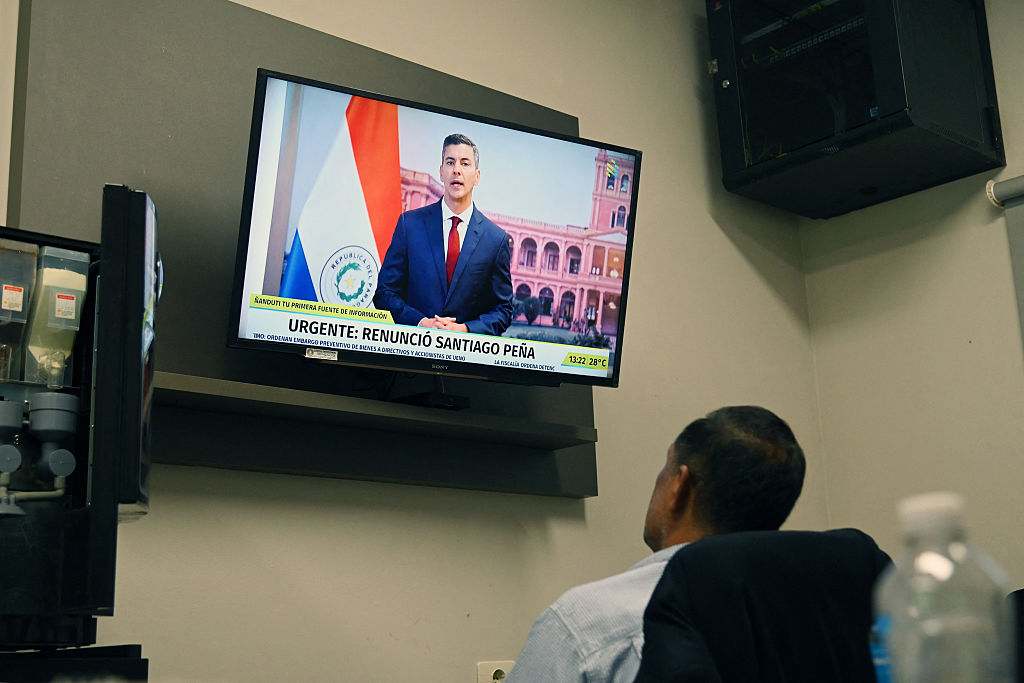
Paraguayan President Santiago Peña submitted his resignation on Nov. 5 and, minutes later, the lower house of Congress voted unanimously to impeach him amid the fallout from the collapse of Ueno Bank. The country has seen days of protests after the central bank seized the digital lender on Nov. 3, as the savings of about 3 million customers—more than half of Paraguay’s adult population—were frozen.
According to media reports, until last year, Peña held shares in Ueno Holding. During his administration, the bank received substantial deposits from public entities, including the Social Security Institute (IPS), which manages pensions and health funds for millions of Paraguayans. Peña also drew criticism for appointing Carlos Carvallo, president of Ueno Bank’s predecessor, Financiera Ueno, to run Paraguay’s central bank. Carvallo resigned from his post earlier this week.
A conservative former IMF economist, Peña had been in office since August 2023 and was seen as a strong ally of the Trump administration. In a video address, Peña announced that he had decided to resign “with the stability of our country, social peace, and the need to preserve our democratic institutions in mind.” Former President Horacio Cartes, the head of the ruling Colorado Party, endorsed the effort to impeach Peña.
AQ asked analysts to share their reactions.

Julieta Heduvan
Consultant and academic researcher affiliated with CONACYT, FLACSO and ALADAA in Paraguay
Santiago Peña’s departure from government represents a watershed moment in Paraguay’s political crisis, but the Ueno Bank collapse will have consequences far beyond the immediate political outcome. At stake is not simply the future of a financial institution, but the credibility of a country that has spent years trying to establish itself as a stable, reliable destination for international investment.
Ueno was not just another bank. Its digital wallet, simple to use and offering significant benefits, became one of Paraguay’s most widely used financial platforms. For a considerable part of the informal economy, it represented the main, and sometimes only, point of access to banking services. Millions of people used it to receive salaries and pensions, make payments and manage their everyday finances. The disruption has a social dimension that should not be underestimated, even as mechanisms are put in place to return a significant portion of deposits.
However, the scale of the crisis extends beyond the domestic economy. Ueno had also attracted major international investors, and by September of this year, the bank reported $510 million in international financing. Its exposure to foreign capital markets makes this a reputational issue for Paraguay, not merely a domestic banking problem.
Perhaps the most troubling aspect is the institutional environment that allowed this expansion. The concentration of political and business interests, questions surrounding the independence of financial regulators, and the placement of substantial public resources, including pension funds, in the bank raise serious concerns about conflicts of interest and the use of public money to sustain its growth. These issues require independent investigation and accountability. The fact that depositors may recover part or most of their funds does not resolve these questions.
For years, Peña’s government worked to project an image of economic stability, culminating in Paraguay achieving the coveted investment-grade status. Yet at the same time, political and business networks were developing in ways that now threaten to undermine those efforts.
Paraguay’s international credibility will take a significant hit. Investors will look not only at Ueno’s financial outcome, but also at what this episode reveals about institutional safeguards, regulatory independence, and the relationship between political power and private capital. A change of government may open a path toward rebuilding trust, but it will not erase the damage already done.

Gregory Ross
Senior Associate, McLarty Associates
For a president who cultivated an image as an investor-friendly technocrat after taking office in 2023, Santiago Peña’s resignation and subsequent impeachment on November 5 mark a sharp turn. The crisis triggered by Ueno Bank’s collapse sits at the intersection of finance and politics, creating reputational risk just as Paraguay was beginning to put itself on the international map.
Addressing the crisis with the full legal and political response it warrants will be critical to reassuring Paraguayans and foreign investors that the country’s institutions are responsive and that its growth trajectory remains intact. In the best-case scenario, the crisis will be contained as a serious but isolated episode. Regardless of its ultimate implications, it should renew attention to the rule of law and motivate institutional reforms in the judiciary and the financial sector.
Key institutions have taken appropriate initial steps, including the Central Bank’s intervention on November 3, the preventive detention of Ueno Bank executives, and the passage of legislation to facilitate depositors’ access to their funds. With Vice President Pedro Alliana set to assume the presidency, the government’s actions in the coming days and weeks—including potential criminal investigations—will also be shaped by internal Colorado Party politics ahead of the 2028 election cycle, which this week’s events have brought into clearer focus.
Although the Ueno Bank debacle is a setback for Paraguay’s growing regional ambitions, the broader foundation of macroeconomic stability built by successive governments over the past two decades should remain intact. For Brazilian and Argentine investors in particular, Paraguay will remain attractive for its relatively low regulatory burden and assets such as surplus hydroelectric power, a competitive agribusiness sector, and growing logistics capabilities. Paraguay’s longstanding partnership with the United States will also remain strong, but the implementation of overdue institutional and judicial reforms will be critical to expanding the bilateral relationship beyond security and geopolitical alignment and toward deeper trade and investment ties.