


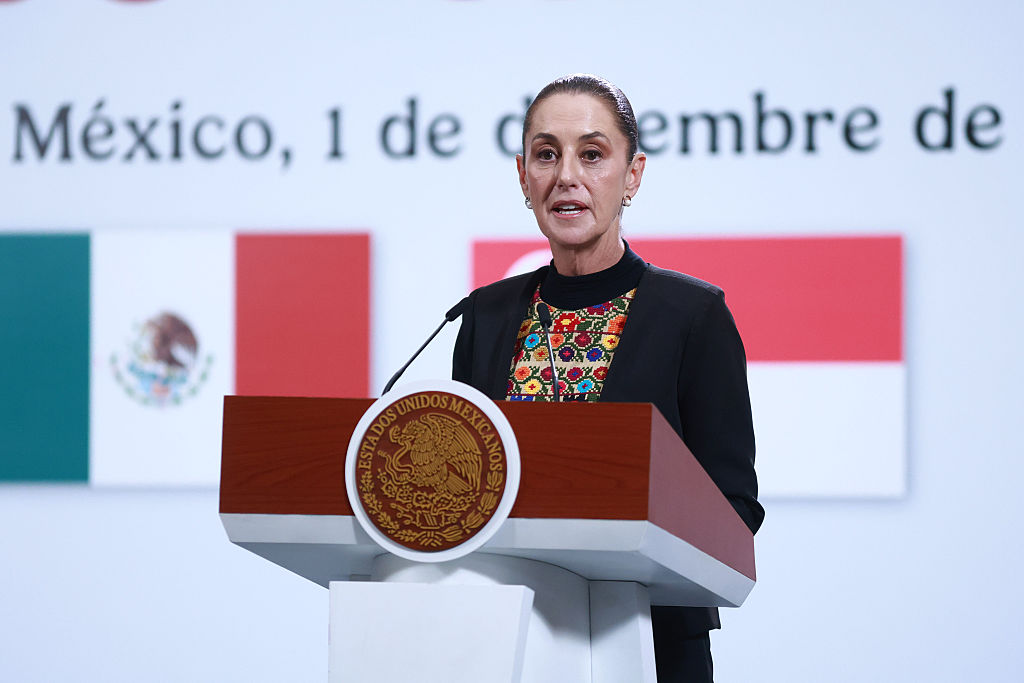
After a smoother-than-expected first year in office, Mexico’s President Claudia Sheinbaum is now facing several thorny economic policy decisions in her second year.
Analysts predict Mexico’s GDP will grow by only 0.5% in 2025, a fourth straight year of deceleration that would place the country near the bottom of the G20 and OECD growth charts. Only a modest rebound to 1.3% growth is forecast for 2026. The country also faces a fiscal reckoning, as the burst of government spending during the 2024 election year left the budgetary deficit at a 36-year high.
At the same time, Mexico’s public investment remains considerably lower than in other Latin American economies, and private consumption’s “slow momentum” already started materializing earlier this year amid U.S. uncertainty and lower growth in real wages. Until now, the economic strain, plus recent protests over deteriorating public security, has not taken much of the sheen off Sheinbaum’s public image. Still, her approval rating has been trending downward, staying at 70% in November, but considerably lower than the 81% she registered in January. While her predecessor, Andrés Manuel López Obrador, led under weak economic conditions without suffering a significant political cost, Sheinbaum may not enjoy the same luxury going forward.
A career technocrat and trained scientist, Sheinbaum is likely looking for a formula to get Mexico’s economy back on its feet. While the road ahead is painful and may go against the political instincts of her leftist party, Morena, three steps would help restore the confidence of investors and everyday Mexicans alike.
Rethinking PEMEX and CFE
If Mexico wants to preserve the investment-grade status it has enjoyed since March 2000, two ticking time bombs and one long-term issue require urgency and care. The two state-owned companies, Petroleos Mexicanos (PEMEX) and Comisión Federal de Electricidad (CFE) lead the to-do list. AMLO’s energy policies poured taxpayer money into the two entities without a clear and viable plan to make them profitable and sound.
Between 2019 and 2024, the government transferred the equivalent of almost $71.5 billion to PEMEX—equivalent to 4.1% of 2024 GDP. This sum accounts for nearly three-quarters of the company’s total debt load of about $100.2 billion, a staggering fiscal support for an archaic and dysfunctional business model that has inhibited much of the needed large-scale private-sector participation via partnerships.
CFE’s current challenges stem from its financial liabilities, inefficiencies, and uncertainty about the future of its partnerships with the private sector. The state power company relies heavily on government funding to maintain its operations. Between 2019 and 2024, Mexico transferred $23.5 billion to CFE—equivalent to 1.4% of 2024 GDP. This sum accounts for 94% of the company’s entire debt load of about $25.4 billion. Given the horizontal effect of power on productivity and competitiveness, there is a vast number of projects from the private sector waiting for certainty signals to be deployed.
CFE needs to clarify its goals to market players to ensure energy security, sufficiency, and sustainability, which are essential for growth-driving sectors like automotives, electronics, and new technologies, especially as the nearshoring narrative is likely to be strengthened through a next-generation free trade agreement with the U.S.
Rein in the deficit
The massive social assistance programs and fiscal deficit represent the second time bomb in Sheinbaum’s hands. It stems from government spending that increased from 4.2% to 6.7% of GDP during AMLO’s six-year term and that lacked adequate transparency and rational targeting. According to the Institute of Inequality Studies (INDESIG), the wealthiest 10% of the population captured almost 12% of social spending by 2024, up from 3.2% in 2018, while some poor families received less assistance than before.
These twin pressures, along with increasing expenditure rigidities—such as debt servicing (accounting for 17% of public income), pensions, transfers to states and municipalities, and undisclosed electoral spending—converged in 2024’s fiscal spree. As a result, Mexico’s budgetary deficit skyrocketed from 2.1% of GDP when AMLO took office to a 36-year historic high of 5.7% of GDP in 2024.
Faced with this inheritance, Sheinbaum promised aggressive fiscal consolidation, initially targeting a deficit reduction to 3.9% of GDP by 2025, followed by 3.2% in 2026. However, the 2026 budget confirmed the unfeasibility of this goal, as spending commitments have become increasingly rigid and locked in, leaving minimal room for such adjustment. The Finance Ministry now projects deficits of 4.4% for 2025—excluding any of the nation’s central operational transfers—and 4.1% for 2026, delaying convergence to the long-term 2.5% target.
The $543 billion 2026 budget details reveal why Sheinbaum’s consolidation efforts will face structural hurdles this year and next. PEMEX continues to devour taxpayer money, with allocations expected to reach $14 billion in 2026—nearly double the 2025 transfers. Furthermore, the budget is increasingly concentrated in areas such as subsidies, pensions, and debt servicing, which together account for almost 44% of total spending, up from 33% when AMLO took office.
This higher share crowds out budget from growth-enhancing public investment, which will remain significantly lower (2.5% of GDP) than in other Latin American economies (3.5%) and the OECD average (3.8%).
Addressing the productivity issue
Besides effectively navigating USMCA negotiations with the U.S., which are likely to result in a revamped agreement that includes some form of sectoral customs union, the most critical challenge confronting Sheinbaum’s administration is reversing the productivity stagnation that has prevented Mexico from realizing its full economic potential over the last three decades.
Close inspection of recent years reveals a clear downturn after 2018—even before the COVID shock—with labor productivity declining further from already-stagnant levels.
This worsening underperformance reflects, among other constraints, multiple structural gaps across regions and sectors. Highly productive and trade-integrated northern states contrast sharply with underperforming southern regions, creating deep inequalities that limit national competitiveness.
A clear example is that despite Mexico becoming the leading import provider to the U.S., only 5% of SMEs participate in foreign trade, revealing the economy’s window of opportunity to harness its nearshoring potential into broad-based productivity gains.
The productivity challenge extends beyond infrastructure bottlenecks to encompass human capital deficits, regulatory obstacles, lack of cutting-edge technology adoption, and most recently, growing concerns about the rule of law and concentration of power.
For instance, Mexico faces a significant skills mismatch in the labor market. According to the Mexican Institute for Competitiveness (IMCO), seven out of ten employers report difficulties filling jobs due to a lack of appropriate skills, revealing the potential to transform scholarships and dual vocational programs into effective tools for workforce reskilling and expanding female labor participation.
The OECD estimates that a comprehensive supply-side reform agenda—facilitating female employment, strengthening the rule of law, raising human capital, and increasing public investment—could boost Mexico’s GDP per capita by 15.6% over ten years, implying an average annual growth increase of 1.6 percentage points.
The opportunity before this government is to transform recently launched industrial strategies and newly created agencies—Plan México and the Agencia de Transformación Digital—into genuine pathways for growth and prosperity, but this starts with creating a reliable business environment with clear general rules of the game so that specific projects materialize.
Addressing the issues discussed above would require steps that are politically sensitive. But they are essential to prevent the economy from sliding further behind its peers and potential, and to provide a credible path to restore Mexico’s confidence, maximize investment opportunities, and promote medium-term growth.
Policymaking is often about choosing the “least bad” option available, especially when fiscal room is shrinking and geoeconomics are extremely challenging. Sheinbaum faces such constraints as she enters her second year as president. While sweeping reforms remain desirable, a step-by-step approach could help regain trust and foster an enabling environment for better outcomes.
ABOUT THE AUTHOR

Vanessa Rubio
Reading Time: 5 minutesRubio is professor of practice at the School of Public Policy at the London School of Economics (LSE) and senior advisor at McLarty Associates. Rubio is a former senator in Mexico and three times deputy minister: finance, foreign affairs and social development.