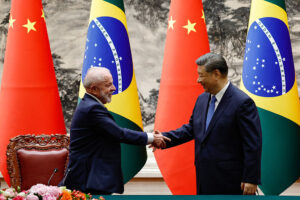



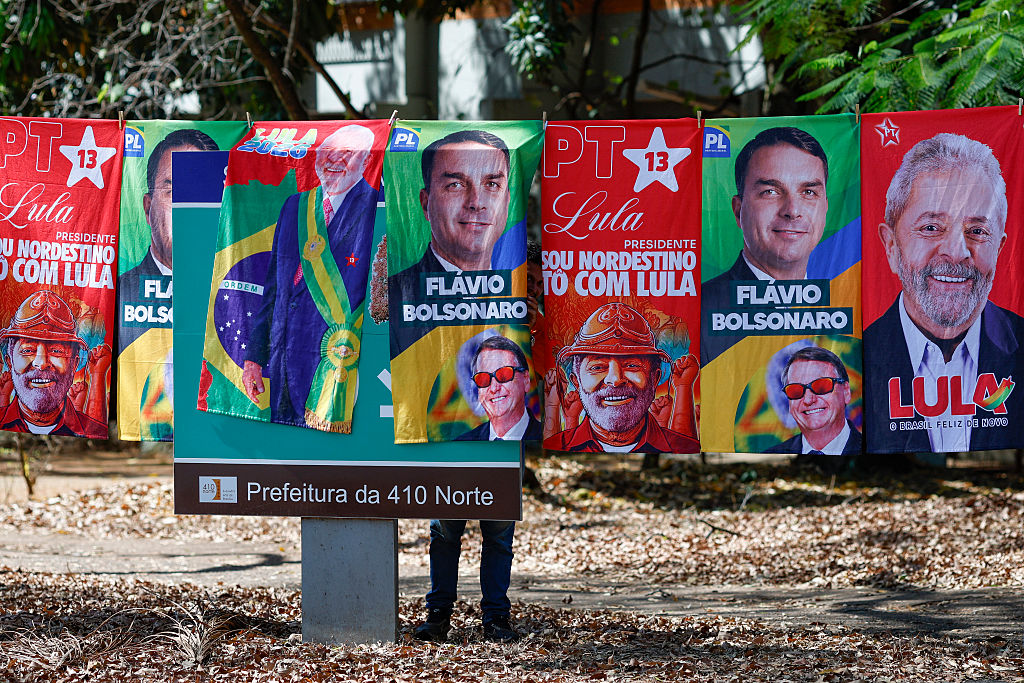
SÃO PAULO—Brazil’s October election presents Washington with a genuine foreign-policy contrast. President Luiz Inácio Lula da Silva’s platform places strategic autonomy, universalist diplomacy, BRICS, and the Global South at the center of Brazil’s international role. Meanwhile, Senator Flávio Bolsonaro’s campaign promises to repair relations with the U.S. and other traditional partners, restore a more pragmatic diplomacy, and give greater weight to trade, investment, and engagement with Western institutions such as the OECD.
Yet this does not translate neatly into a choice between Washington and Beijing. Lula seeks diversified partnerships and rejects the logic of a new Cold War. Bolsonaro favors negotiating with everyone, “from China to the European Union, from the United States to Asian markets,” while avoiding excessive dependence on any one partner. In other words, Lula would not exclude the U.S., and Bolsonaro’s greater receptiveness to Washington would not amount to automatic alignment on every issue.
The reason is partly structural: China is embedded in Brazil’s commercial and production networks. In the first eight months of this year, China absorbed 30.7% of Brazilian exports, compared with 9.6% for the U.S., according to official trade data.
Former president Jair Bolsonaro’s own trajectory illustrates the constraints. During the 2018 campaign, he warned that China was “buying Brazil,” and advisers in his foreign-policy circle cast Beijing as an ideological threat. Once in office, however, he adopted a more pragmatic stance toward China, encouraged trade and investment, and ultimately left Huawei eligible to supply Brazil’s 5G networks despite pressure from Washington. Agribusiness was central to that adjustment: with China as the leading buyer of Brazilian soybeans and other farm exports, the sector had strong incentives to prevent an ideological dispute from jeopardizing its largest market. The episode offers a useful precedent: even a government elected on sharply anti-China rhetoric found that Brazil’s economic structure imposed limits on alignment with the U.S.
Similar logic applies to Brazil’s critical minerals, where trade, industrial policy, technological competition, and national security intersect. Rare earths, a subset of that broader category, are essential to the magnets used in electric vehicles, wind turbines, electronics and defense systems and more. A study prepared for Brazil’s Ministry of Mines and Energy by CEBRI and Vallya estimates that China accounts for about 70% of the world’s rare-earth production and 94% of magnet manufacturing. Brazil holds an estimated 23.1% of the world’s rare earths, with reserves of 21 million metric tons.
Those numbers make Brazil attractive to Washington. While Lula and Flávio Bolsonaro each have their own strategies to capitalize on Brazil’s rare-earth resources, their strategies are not as different as one might assume. Despite all the talk of polarization, the country’s political spectrum still largely agrees on trade, especially issues like critical minerals. The election outcome is unlikely to change this.
Common ground
Lula’s platform treats critical minerals as part of a state-coordinated strategy of reindustrialization and technological sovereignty. He proposes organizing supply chains, expanding domestic processing, and preventing the “simple export” of strategic raw materials. Meanwhile, Bolsonaro’s program offers a more market-oriented model: the state as regulator and coordinator rather than entrepreneur. He emphasizes market incentives, faster technical licensing, and stable rules to attract private investment and therefore technology transfer.
But Bolsonaro’s platform, for example, also rejects exporting raw materials and emphasizes domestic value addition and local employment. And neither defines Brazil’s interest as maximizing extraction for a preferred foreign buyer.
That position is now reinforced by law. Brazil’s new Law 15,506 makes domestic value addition, technology transfer, regional development, and sovereignty key objectives of its critical-minerals policy. It also provides mechanisms to screen for changes in corporate control, outsize foreign influence, transfers of mining rights, and international supply agreements that could affect Brazil’s economic or geopolitical security. It specifically allows export-related value-addition requirements and creates a council to monitor these factors, including states, municipalities, companies, and universities.
When it was debated in the Senate earlier this year, the bill drew input and support from lawmakers across the political spectrum. Even amid intense political polarization, lawmakers found plenty of common ground on critical minerals.
Core frameworks
Whoever wins the election, they will not control the rare earth supply chain unilaterally. Right off the bat, projects depend on approval from Congress, the National Mining Agency, environmental authorities, state and local governments, concession holders, investors, and affected communities. Rare-earth deposits may also contain naturally occurring radioactive materials such as thorium, bringing nuclear-safety bodies into the process. A Flávio Bolsonaro administration might prioritize faster decisions and U.S.-backed investment, while a Lula government might demand more stringent conditions. Even so, neither could bypass the sector’s legal, federal, and social architecture.
The acquisition of Serra Verde in the state of Goiás shows what meaningful access requires. The announced package included a 15-year agreement covering 100% of Phase I production, guaranteed floor prices, and a $565 million financing deal with the U.S. International Development Finance Corporation. The U.S. improved its position by providing capital, risk protection, and a long-term market, not simply political goodwill. Brazil’s new screening and value-addition frameworks require these kinds of outlays from prospective partners.
What Washington may misread, then, is what the contrasts between Lula and Bolsonaro might actually mean in practice. The two candidates place different weights on strategic autonomy, markets and ties with the U.S., which shape project selection and bargaining style. Either way, however, Brazil’s core interests, frameworks, and institutions will not change much, and they will continue to define the country’s posture on a range of key policies, including trade with China, critical mineral supply chains, and other issues.
Essentially, political affinity will not automatically translate into commercial access or strategic control. The election outcome might shift affinity and facilitate access, but it will not guarantee control. No matter who wins, the U.S. and its firms will have to make offers that treat Brazil not merely as a commodity supplier, but as a country seeking a larger place in the value chain.
ABOUT THE AUTHOR

Fernanda Magnotta
Reading Time: 4 minutesMagnotta is a senior fellow at the Brazilian Center for International Relations and a professor of the International Relations Program at Fundação Armando Alvares Penteado in São Paulo.
The Donroe Doctrine’s China Paradox
Washington’s increasing focus on political alignment may be giving the region more reasons to keep China close.
Can Brazil and the U.S. Reach a Deal on Rare Earths?
As Washington seeks to loosen China’s grip on high-tech and defense supply chains, Brasília holds a strategic play.