



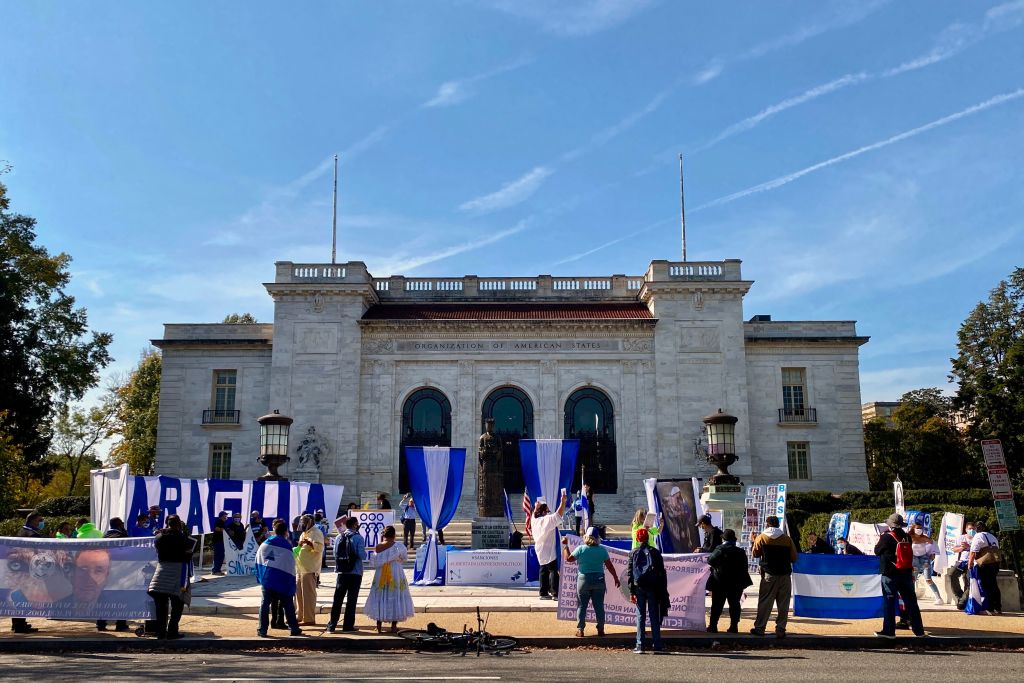
MEXICO CITY—On September 11, 2001, in a special session of the General Assembly of the Organization of American States (OAS), foreign ministers from around the Americas gathered in Lima to sign the Inter-American Democratic Charter (IADC), which for the first time declared democracy to be a right and established new multilateral mechanisms to defend it. When terrorist attacks hit the twin towers in New York, officials expedited the hearing in a show of hemispheric solidarity so that then-Secretary of State Colin Powell could return quickly to Washington.
As the twenty-fifth anniversary approaches, the document will probably—once again—be overshadowed by the other more tragic events of that day: the attacks in New York and the coup against Salvador Allende in Chile in 1973. But recent months have reminded us that the IADC is as relevant as ever, for its accomplishments, shortcomings, and what its story over the last quarter-century tells us about the state of democracy in the Americas today.
The IADC remains best known for its first article: “The peoples of the Americas have a right to democracy and their governments have an obligation to promote and defend it.” That affirmation, though perhaps taken for granted today, was hard-won in a region known for its suspicion of any type of foreign intervention, especially in the name of democracy.
The Democratic Charter was an immediate reaction to Peru’s painful ten-year slide into authoritarianism under President Alberto Fujimori; its original Peruvian advocates sought to create a hemispheric bulwark against antidemocratic forces to ensure no country would ever have to endure what they had. The Peruvian experience underscored the need to protect the hemisphere’s democracies not only against coups d’état but also against slow-motion authoritarian backsliding by democratically elected presidents like Fujimori, which often slipped under the radar.
A critical role
The IADC was the culmination of the rise of what then OAS Secretary General César Gaviria called a “democratic solidarity paradigm” during the 1990s, which was intended to protect the hemisphere’s still-fragile democracies after decades of authoritarianism. Chapter IV incorporated mechanisms to make it more than just a statement of ideals. Like a ladder of escalating consequences, its clauses include built-in flexibility to provide democratic solidarity for OAS member states under serious authoritarian threat, as well as to ratchet up pressure against would-be dictators.
If more constructive and peaceful measures to restore democracy do not work, the OAS can adopt punitive measures, such as suspending member states, as it did against Honduras in 2009 following Roberto Micheletti’s coup. The IADC also enshrines an electoral validation/invalidation norm that empowers the OAS as an electoral referee whose observation missions can speak out when the conditions for free, fair and transparent elections do not exist.
Since its founding, the IADC has been present in numerous OAS declarations and resolutions against authoritarian threats, either referred to in principle or invoked through specific clauses of Chapter IV. The latter have been applied in support of democracy in Bolivia, Ecuador, Guatemala, Honduras, Nicaragua, Peru and Venezuela, often on repeat occasions. As recently as this July, a high-level mission visited Bolivia to promote dialogue and stabilize its democratic system, based on an OAS resolution that alluded to the Democratic Charter. In August, the OAS Permanent Council resolution convening an urgent foreign ministers’ meeting for September to counter Nicaragua’s President Daniel Ortega’s intentions to do away with elections and constitutionalize authoritarianism underlined the action’s consistency with the IADC.
Nonetheless, critics have noted that the Democratic Charter’s application has suffered from several shortcomings in practice. For example, its text does not provide a clear definition of what threats constitute serious violations, and its legal status as a resolution rather than a treaty leaves its operationalization subject to the political interpretation of OAS member states. The IADC’s usage is vulnerable to swings in the constellation of political forces and geopolitical and ideological trends across the hemisphere.
Indeed, the IADC’s application has been inconsistent and unequal. This predicament has not been helped by the hemisphere’s ongoing ideological polarization. Governments on the right and left seem to try to impede the application of the Democratic Charter against one of their own. This pattern is illustrated by the lack of collective action against Nayib Bukele’s undermining of democracy in El Salvador since assuming office in 2019, or Mexico and Brazil’s decision in recent days not to support a meeting of consultation of foreign ministers to consider diplomatic action against Ortega’s dictatorship in Nicaragua. Analysts have also pointed out that collective action under the Democratic Charter has targeted smaller or medium-sized states more than regional powers, even as threats to democracy have risen in Brazil, Mexico, and the United States in recent years.
Credibility and reliability
The IADC’s ability to uphold democracy also depends on the U.S. credibility and reliability as a partner. In 2004, the U.S. government failed to support the use of the Democratic Charter in favor of Haitian president Jean-Bertrand Aristide before he was ousted. During the Honduran crisis in 2009, a widespread sense of betrayal spread across the hemisphere when Washington allegedly reneged on its earlier pledge not to recognize the winner of the October presidential election that year unless ousted president Mel Zelaya was restored to power first.
It also appears as if the U.S. has weaponized the IADC in recent years as a tool against adversarial authoritarian governments of the left while ignoring the antidemocratic wrongdoings of allies or friends at particular moments such as Honduras and El Salvador. U.S. credibility is also questioned by recent actions or lack thereof in Venezuela, including the capture of Nicolás Maduro on January 3 and the seeming lack of commitment to a firm timetable for elections, essential for the restoration of democracy.
Although the IADC is criticized for privileging incumbent presidents and member states at the expense of access for citizens and civil society, it has also inspired a plethora of other actors to act. Since 2024, human rights non-governmental organizations have rallied in support of the Guatemalan government’s formal request for an advisory opinion from the Inter-American Court of Human Rights on the right to democracy as enshrined in the Democratic Charter.
With the ongoing securitization of the hemispheric agenda, mounting U.S.-China rivalry, and the fight against narcotrafficking and migration, it is unlikely that governments in the Americas have much appetite for a full-blown revision of the Democratic Charter.
Despite its flaws, the Democratic Charter has repeatedly proven its worth in modest yet meaningful ways. The IADC remains what diverse actors (not just presidents and states) make of it. Given current and emerging threats to democracy in the Americas, we can expect them to work both within and outside the OAS to find creative ways to activate the Democratic Charter for years to come.
ABOUT THE AUTHOR

Thomas Legler
Reading Time: 4 minutesLegler is a professor of International Relations at the Universidad Iberoamericana Ciudad de México.
Support for Democracy—but also Strongmen—Is Rising in Latin America
For the first time in a generation, democracy is considered the best form of government. At the same time, China is now more trusted than the U.S.
The High-Stakes Threats to Latin American Democracy
Latin America’s impressive progress on electoral democracy, perhaps its most important achievement of recent decades, could soon be rolled back.