



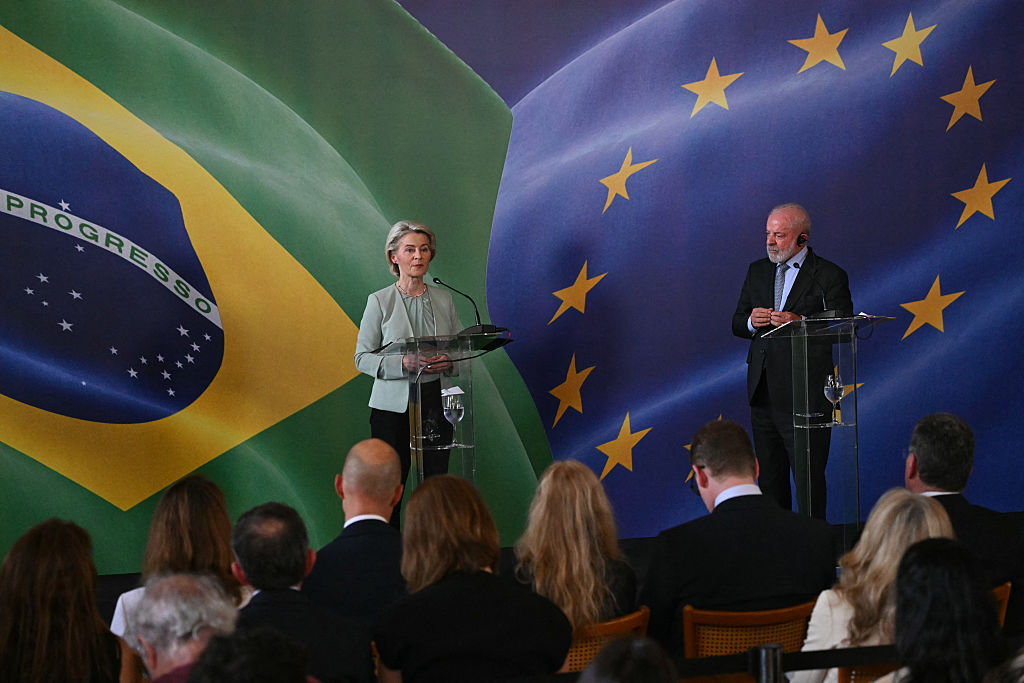
SÃO PAULO — After more than two decades of negotiations, the EU–Mercosur trade agreement is set to enter provisional application on May 1. Its arrival is not a triumph of free trade, but rather as something more consequential: a test of whether Latin America and Europe can still anchor their economic relationship in rules and institutions at a time when the global economy is moving in the opposite direction.
The timing is instructive. When talks began in 1999, the goal was straightforward trade liberalization. By 2019, when an agreement in principle was announced, the context had already shifted. Environmental concerns—especially over deforestation in the Amazon—derailed ratification in Europe, while political tensions and domestic opposition on both sides slowed progress.
What followed was not just a delay, but a period of political erosion, compounded by European farm lobbies, divergent regulatory priorities, and deep skepticism about Brazil’s environmental governance under Jair Bolsonaro. The renegotiation—particularly with Brazil, aimed at increasing binding environmental commitments in exchange for forgoing some of the market access gains achieved in the 2019 arrangement—reflected a new reality: trade agreements are no longer judged on tariffs alone but on climate, governance, and political legitimacy.
The revised deal, finalized in 2024, reflects that shift. The European Union pushed for stronger environmental commitments, while Mercosur countries accepted more limited market-access gains than originally envisioned. The result is a compromise that survived not because disagreements disappeared, but because the cost of failing to reach an agreement became too high—especially in a world increasingly defined by supply-chain competition and geopolitical rivalry.
For Latin America, particularly Brazil and Argentina, the agreement offers both opportunity and constraint. On paper, it creates a trading zone of more than 700 million people with the opportunity to expand bilateral trade exponentially in the years to come, as the deal is expected to gradually eliminate tariffs on thousands of products, benefiting sectors such as agriculture and certain industrial exports.
Yet the gains, while meaningful, are unlikely to be transformative on their own. The more important question is how the region uses improved access to European markets. Will it serve as a platform for industrial upgrading, infrastructure investment, and higher-value production? Or will it reinforce a long-standing pattern in which South America exports commodities while importing higher-value manufactured goods?
A new crossroads
For the European Union, the deal serves a function that goes well beyond market access for cars and pharmaceuticals. The Peterson Institute for International Economics estimated that in 2023, the EU sourced 100% of its heavy rare earth minerals from China, and demand for lithium alone is projected to increase twelvefold by 2030 and twentyfold by 2050.
Mercosur, and especially Brazil and Argentina, is relevant to several of the inputs Europe needs most. Mercosur countries are major producers of key critical raw materials, such as lithium, niobium, tantalum, and natural graphite, making the partnership strategically important for Europe’s green and digital transition. The agreement, by locking in non-escalation tariff clauses and enforceable dispute mechanisms, offers something that bilateral memoranda of understanding with extractive intent cannot: a durable institutional framework for long-term investment.
For Brazil, the arithmetic is similarly compelling but should be read with care. Brazil’s Vice President Geraldo Alckmin expects exports to increase by 13% by 2038 through full enforcement of the deal, with industrial exports potentially rising by 26% in the same period. Tariff cuts are gradual, with duties on roughly 5,000 products reduced to zero as of May 1 and full liberalization expected within 12 years.
Trade between Brazil and the EU amounted to about $100 billion last year, with the EU as the country’s second-largest trading partner after China. Sales of sugar, fruits, beef, and poultry stand to benefit in the near term. These are meaningful gains. But they are not transformative in themselves. The deeper question is whether Brazil will use preferential market access as leverage for industrial policy, value-added production, environmental traceability, and infrastructure investment, or simply deepen its commodity export profile, which the agreement, in structural terms, does little to discourage.
The other side
That tension is not unique to the Mercosur side. In Europe, trade has become domestic politics by other means. France and Poland have been two of the strongest opponents of the deal, with critics arguing it would sharply increase imports of beef, sugar, and poultry and undercut domestic producers. Poland announced it will file a complaint before the Court of Justice of the European Union, citing risks to food security, consumer safety, and domestic market protection.
The European Parliament had already moved to request a legal opinion from the Court on whether the agreement’s structure — splitting the deal into separate instruments to allow the trade pillar to proceed without waiting for ratification of the broader agreement by all national parliaments — is compatible with EU treaties. The vote was tight: 334 to 324. These are not irrational objections dressed up as protectionism. They are expressions of a legitimate anxiety about whether multilateral agreements can still deliver equitable outcomes within democratic polities.
The environmental dimension deserves equal seriousness. The Commission argues that the agreement contains binding commitments on climate, labor rights, and sustainable development. European farm groups and environmental NGOs contend that such provisions remain insufficiently operational to constrain agroindustrial expansion in the Amazon basin and the Cerrado. Both positions contain partial truths. The credibility of the sustainability chapter will not be established by its text but by whether the monitoring and enforcement mechanisms are actually resourced and activated. Sustainability cannot function as a reputational annex if the agreement is to withstand judicial and political scrutiny over the next decade.
The real opportunity
What this moment requires is a more honest framing of what the EU-Mercosur deal is and is not. It is not the restoration of liberal globalization. It is not a guarantee of development for either side. It is a carefully constructed institutional bet that two regions facing marginalization in a world increasingly organized around blocs, coercion, and strategic dependency can still build something durable together.
While Washington has increasingly relied on tariff pressure and transactional bargaining, Europe is pursuing similar goals by negotiating trade deals that encourage capital investment in partner countries. That distinction matters. Agreements anchored in a binding legal architecture create incentives and expectations that differ from those of executive-branch bargaining and from those for investors operating over long investment horizons.
The agreement will not succeed simply because tariffs fall on May 1. It will succeed only if both regions treat it as more than a market-access instrument. Europe will need to demonstrate that strategic autonomy is compatible with social protection at home.
Mercosur will need to demonstrate that competitiveness can coexist with environmental credibility and industrial upgrading. The promise is real, and so is the fragility. That is precisely why, in a world drifting toward fragmentation as its default architecture, it matters.
ABOUT THE AUTHOR

Fernanda Magnotta
Reading Time: 4 minutesMagnotta is a senior fellow at the Brazilian Center for International Relations and a professor of the International Relations Program at Fundação Armando Alvares Penteado in São Paulo.