


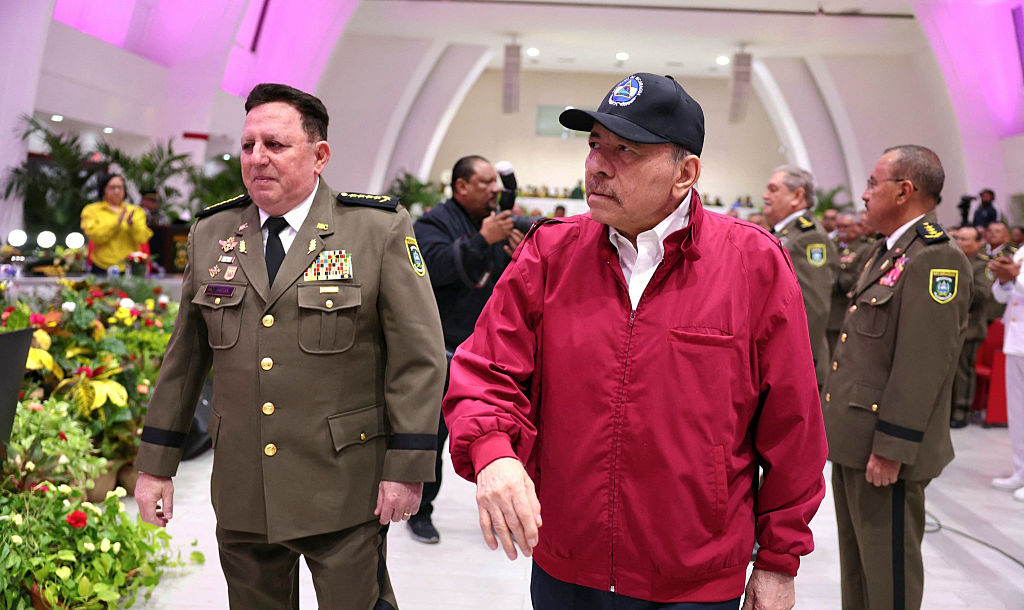
Days ago, Russia’s Federation Council ratified a military cooperation agreement with Nicaragua, formalizing a wide-ranging security framework initially signed in Moscow in September. The accord considerably expands military cooperation through joint training and intelligence exchanges between the two countries, extending Nicaragua a possible lifeline at a time when its ideological allies Cuba and Venezuela are under huge pressure from the United States.
For Moscow and embattled President Vladimir Putin, it signals continued geopolitical reach in the Western Hemisphere. For Nicaragua’s co-Presidents Daniel Ortega and Rosario Murillo, it reinforces a broader authoritarian survival strategy built on external alliances.
Russian and Nicaraguan official channels describe the accord primarily as a framework for expanded military cooperation rather than permanent basing or strategic weapons deployment. This is not a replay of the Cuban missile crisis, nor is Nicaragua suddenly a Russian military base.
However, the new agreement deserves attention not because it signals some grave new threat, but because it signals continuity. It is a reminder that the international community has failed to prevent the Ortega-Murillo regime from dismantling Nicaragua’s democracy, and that this regime will continue to try to hollow out the country. It comes in a moment when Latin America is going through a post-Nicolás Maduro moment, and Cuba faces renewed Washington scrutiny.
The agreement also signals that the Ortega-Murillo system increasingly sees its long-term survival tied not to domestic legitimacy, but to external authoritarian partnerships. That matters because Nicaragua is already evolving beyond a personalist presidency toward a dynastic political structure centered on the Ortega-Murillo family. The more deeply Nicaragua becomes embedded in security, intelligence, and diplomatic ties with countries such as Russia, China, and Iran, the easier it may be for the regime to maintain continuity even after Ortega eventually leaves the political stage. In that sense, the agreement is less about immediate military escalation than about institutionalizing authoritarian resilience, and this accord has the potential to help Ortega-Murillo keep power.
Ortega’s embrace of Moscow is part of a survival strategy increasingly visible among authoritarian governments: weaken internal checks on power, criminalize dissent, and seek external partnerships with foreign powers willing to make deals without democratic conditions.
In response, the right course of action for the international community is not to saber-rattle, but to seek opportunities to support Nicaraguan organizations and institutions that could be key to any return to democracy, whether they’re in exile or still in the country.
Authoritarian consolidation
Over almost two decades, Ortega’s government has transformed Nicaragua from a fragile democracy into one of the Western Hemisphere’s most consolidated authoritarian systems. The turning point came after the 2018 nationwide protests, when state repression left hundreds dead, thousands injured, and many more imprisoned or forced into exile, according to international human rights monitors. Since then, repression has evolved from episodic violence into institutional redesign.
The regime has worked methodically to eliminate independent centers of power. The Catholic Church has been among the clearest targets. Members of the clergy have been harassed, surveilled, detained, expelled, or stripped of legal protections. Religious orders have been shut down. Public processions have been restricted. The imprisonment and later exile of Bishop Rolando Álvarez became perhaps the most prominent symbol of Ortega’s determination to silence even moral criticism. The message was unmistakable: No institution may stand outside regime control.
Universities have faced similar pressure. Since 2021, the regime has closed, confiscated, or restructured over two dozen higher education institutions, often replacing autonomous bodies with state-aligned entities. Meanwhile, more than 5,000 civil society organizations, charities, foundations, universities, religious associations, and advocacy groups have lost legal status or been forcibly shuttered since 2018. Human rights groups, women’s organizations, development institutions, and humanitarian actors have been shuttered.
What Russia offers
Through the new military agreement, Russia reinforced the message that Managua is not internationally isolated. In return, Nicaragua continues to provide Russia with a politically useful foothold in Central America and a reminder to Washington that Russia retains influence in the region.
For Moscow, these relationships are valuable less because of their direct military utility than because they create geopolitical asymmetry. Russia cannot compete with the United States economically in Latin America, but it can create symbolic pressure points near U.S. borders at relatively low cost. Nicaragua, Venezuela, and Cuba therefore serve as strategic reminders that Moscow still possesses the capacity to complicate Washington’s regional environment even while Russia remains heavily consumed by the war in Ukraine. For authoritarian governments in the hemisphere, these relationships also provide diplomatic alternatives at a moment when many democratic governments and multilateral institutions have become more willing to criticize democratic backsliding and human rights abuses.
Nicaragua is not Cuba in 1962, of course, and Russia today is not the Soviet Union at its Cold War zenith. Moscow’s strategic burdens elsewhere necessarily impose limits on its influence in Central America and the Caribbean. But even absent a formal base, expanded Russian military cooperation can strengthen the Ortega-Murillo regime’s grip on Nicaragua. Symbolism matters in authoritarian politics. In some cases, it matters almost as much as hardware.
This moment should prompt the community of the Western Hemisphere to reflect on its response to Nicaragua’s democratic collapse. Its actions have often been fragmented, inconsistent, and insufficiently strategic. Sanctions have imposed reputational and economic costs, but they have not reversed authoritarian consolidation. Meanwhile, the exile of journalists, priests, academics, students, and political leaders has steadily drained Nicaragua’s civic resilience.
Coordinated answers
In response, regional democracies, multilateral institutions, and democratic allies should focus not only on punishing Ortega but also on preserving Nicaragua’s future democratic infrastructure. That means supporting independent journalism, universities in exile, human rights defenders, religious networks, and civil society institutions capable of surviving beyond the current regime. As democratic space inside Nicaragua shrinks, preserving democratic capacity outside the country becomes ever more important.
For Washington, discipline matters too. Exaggerating Nicaragua as an immediate Russian military threat may create political theater, but it risks strengthening Ortega’s preferred narrative of anti-imperial resistance. A more effective strategy is to focus relentlessly on governance failure, corruption, repression, and the destruction of civic institutions—the regime’s deepest vulnerabilities in the international arena.
Washington’s broader regional posture now sends a sharper signal than it did even months ago. The United States has taken extraordinary action against Nicolás Maduro, including placing him in U.S. custody after a January 2026 military operation, and has sharply escalated pressure on Havana through new sanctions and energy-related measures. Nicaragua, by contrast, has faced sanctions and condemnation, including recent Treasury action against figures and companies tied to the gold sector, but not the same level of sustained strategic attention. That gap matters. If Managua concludes that repression at home and alignment with Moscow bring manageable costs, the Ortega-Murillo regime will have little incentive to change course.
The central question is not merely whether Russian influence expands in Central America. It is whether Nicaragua’s civic foundations can survive long enough to eventually rebuild a democratic future. The deeper lesson for the hemisphere is that authoritarian alliances rarely emerge in a vacuum. They flourish where democratic institutions, independent media, universities, churches, and civil society have first been weakened from within.
ABOUT THE AUTHOR

Steven E. Hendrix
Reading Time: 4 minutesHendrix is chief executive of Hendrix LLC and senior research fellow at DePaul University College of Law. He is a former U.S. diplomat and senior USAID official, and is the author of The New Nicaragua: Lessons in Development, Democracy and Nation-building for the United States.

The Stunning Loss Daniel Ortega Never Forgot
Nicaragua’s 1990 election is a tale of a bygone era—and a strongman who eventually got his revenge.
Will Trump 2.0 Play Tougher on Nicaragua’s Dictatorship?
Initial actions by the White House, such as cutting USAID programs, undermine the country’s struggling opposition.
Nicaragua’s Flip From Taiwan to China Has Yet to Pay Off
Engaging with Beijing was supposed to anchor the nation’s economy, but the decision has not lived up to expectations.