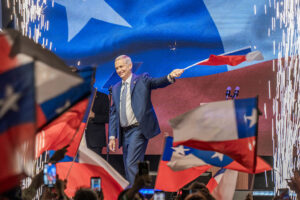



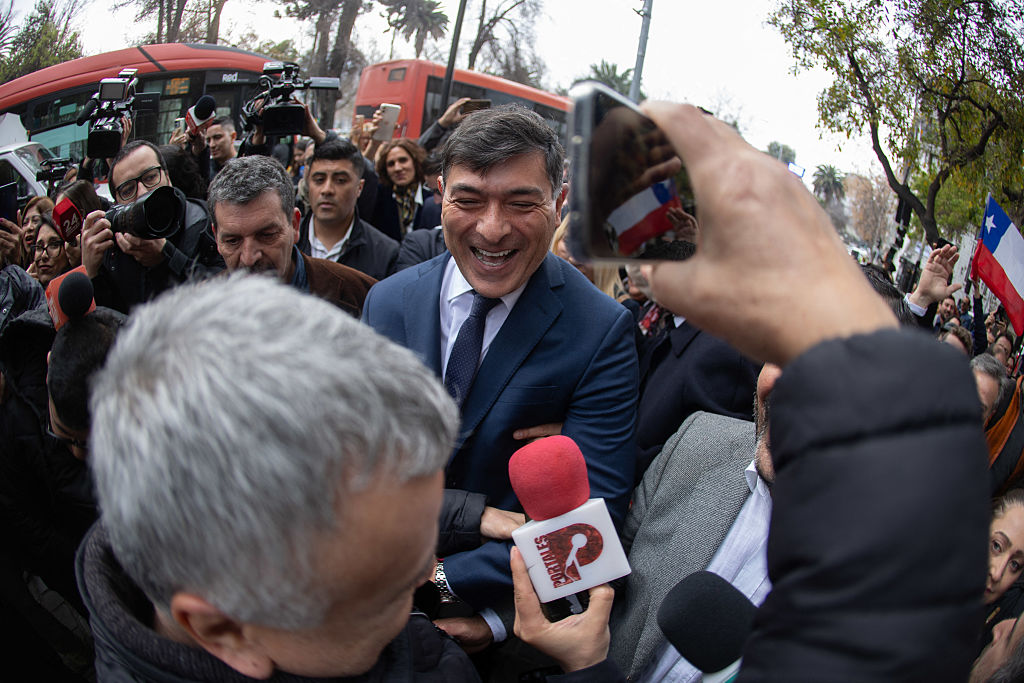
The newest powerbroker in Chilean politics is an anti-establishment party that defines itself as ni facho ni comunacho (slang for “neither fascist nor communist”) and is the latest political movement in Latin America to ride an anti-incumbent wave to challenge established party systems.
The Partido de la Gente (PDG) finished third in the last two presidential elections, with charismatic economist Franco Parisi leveraging this strong support on social media to get 19% of the vote last November. The PDG’s support in Congress has been critical as Chile’s right-wing President José Antonio Kast is on the verge of passing his most critical economic reform bill, the Plan de Reconstrucción Nacional, which aims to revive Chile’s sluggish economic growth by boosting investment through corporate tax cuts and slashing red tape.
After months of congressional negotiations, the Senate approved the bill on August 5. The lower house had initially passed it in May with PDG support. The party’s lawmakers later opposed several Senate amendments but ultimately backed the proposal, clearing it for the final Senate vote.
Parisi founded the PDG in 2019, and outperformed expectations in the 2021 election despite campaigning entirely from the United States because of child support issues in Chile. In the following years, Parisi has continued to build a social media following by railing against the country’s political class, telling voters in the 2025 campaign: “My opponent has no surname. It is the establishment because it takes opportunities away from people.”
Parisi presented a tough-on-crime stance and an anti-establishment vision with an eclectic mix of policies that straddle the left-right axis. He also offered voters a middle-class populism that channels anxieties over affordability and frustrated social mobility into resentment of an establishment it blames for both.
His simple and direct message criticizing the establishment has resonated in a country where 52% of the population do not identify with any party. Many Chileans have lost faith in the country’s traditional politicians on the center-right and center-left following a decade of substandard economic growth, security challenges and two aborted constitutional rewrites.
Although Kast won last November’s election on a strong anti-incumbent message and right-wing profile that aligned with voters’ concerns about crime, migration and the desire for more market-friendly reforms, Parisi was within earshot of making it to the second round. Since coming to power, Kast’s popularity has faded to just 36%, making the need for allies in Congress and elsewhere even more acute.
Parisi is now in Chile and has actively negotiated with the government to get concessions in exchange for votes. The PDG’s support for the reform bill came only after tense negotiations between Parisi and Finance Minister Jorge Quiroz in which the government agreed to concessions that address cost of living issues including tax breaks for diapers and medicines.
Parisi’s powerbroker status comes with risks. Getting too close to the administration would dilute the PDG’s brand with voters and create the perception that it is just another right-wing party, which risks losing its identity and appeal among disillusioned and frustrated voters.
A cautionary tale
Uruguay offers a cautionary precedent in the sudden rise and fall of its own anti-establishment party, Cabildo Abierto (CA). Like the PDG, the Cabildo Abierto startled observers in 2019, taking around 11% of the vote, which netted them 11 seats in the Chamber of Deputies and three seats in the Senate, posing a challenge to the country’s seemingly solid party system. It drew support from lower-middle-class voters and those in the interior with socially conservative views who demanded hardline security measures but leaned left on economics.
In a fateful decision, the CA then joined former President Luis Lacalle Pou’s “multicolor” coalition ahead of the runoff, where polls showed a tight race with the left-wing Frente Amplio. The CA’s support was crucial for Lacalle Pou’s victory. Even though it occasionally broke ranks to vote with the Frente Amplio and pushed reforms Lacalle Pou rejected, its association with a center-right administration drained its distinctiveness.
Scandals compounded the damage, undermining its anti-establishment appeal. The party received just 2.5% of votes in the 2024 election. It nonetheless remains a player: Today, the CA’s two deputies are among the small blocs that can supply the Yamandú Orsi administration the votes it needs to pass legislation.
Hard choices ahead
The PDG has so far avoided the CA’s fate, as Parisi has kept it outside of Kast’s governing coalition. The party’s posture is more pragmatic and transactional, and issue-by-issue bargaining is likely to remain its modus operandi with the Kast administration.
In the short run, Parisi is likely to back Kast’s agenda because he agrees with many of its right-wing tenets. But as the 2029 election approaches, Parisi is likely to become more confrontational with Kast to preserve the PDG’s anti-establishment identity. The PDG may abandon a cooperative approach even faster than expected if Kast’s approval continues to fall as Chile is buffeted by rising inflation and unemployment.
Parisi’s rise shows how polarization in a multiparty democracy can create space for outsiders. The center has been pulled toward the political poles: In the last election, the center-left coalesced behind a leftist candidate and the center-right rallied behind Kast. However, many voters did not identify with this radicalization and withdrew their support for the center. Parisi proved to be a new option for many jilted voters. Now, his challenge, like that of all similarly placed leaders and parties, is to move beyond anti-establishment positioning toward a clear governing agenda, which will require political and policy compromises on his part.
ABOUT THE AUTHOR

Nicolás Saldías
Reading Time: 4 minutesSaldías is a Principal Economist for the Americas at the Economist Intelligence Unit and received his Ph.D. in political science from the University of Toronto.
Kast and Chile’s Investment Reset
The government needs to reconcile growth and legitimacy to boost GDP growth and investor confidence, two experts write.
Kast’s Real Challenge Goes Beyond Security and Order
Chile’s president is facing declining approval and a series of questions about his capacity to lead the country.