


SÃO PAULO—The surprise results of Brazil’s general election on Sunday revealed a country where the right will increasingly set the terms of politics, regardless of who wins the presidency on October 25. The country’s right has built a broader base across institutions, sharing Trumpism’s ability to mobilize political identity but depending less on a single leader’s authority. Across Latin America, right-wing leaders have struggled to translate electoral mandates into governing power or concentrate that power around themselves, and in Brazil, this reality is about to be tested.
This distinction matters for understanding what the runoff will change. Senator Flávio Bolsonaro may bring the presidency into closer alignment with conservative strength elsewhere in government. Parties identified with right-wing ideology won 260 of the 513 lower house seats, with another 81 going to the center-right. Bolsonaro’s Liberal Party elected 121 lawmakers, the largest caucus, and is projected to have 28 senators in the next legislature. Those legislators will not necessarily vote as a disciplined bloc, but the winner would still have to negotiate with a conservative majority.
If President Luiz Inácio Lula da Silva overcomes Sunday’s results in only three weeks, he could resist parts of that agenda, but he would govern in a political environment increasingly defined by his opponents. The presidency remains consequential, but does not capture the full balance of power.
Brazil has long had a conservative Congress, and Lula has considerable experience bargaining with it. What has changed is the political environment surrounding those bargains. Congressional brokers now operate alongside a right with mass loyalties and credible claims to executive competence. Cooperation with a left-wing government remains possible, but the electoral cost of helping it advance has become harder to ignore.
The sources of conservative strength
Understanding this strength requires distinguishing three overlapping parts of the right. “Bolsonarismo” gives the movement a political identity that lasts beyond individual elections and maintains opposition to the left as a mobilizing principle . In grassroots digital activism during the 2022 election, religious framing helped reinforce loyalty and cast institutional oversight as censorship. Such networks sustain mobilization beyond the top-of-the-ticket candidate.
The “managerial right” broadens that appeal. Technocratic São Paulo Governor Tarcísio de Freitas won reelection with 62.65% of valid votes on October 4, and his government’s privatization of the water company Sabesp reflects a political offer built around investment and administrative performance. For voters who share conservative preferences but tire of confrontation, this emphasis on competence provides another reason to support the right. A less combative presentation need not imply a more moderate agenda.
The “transactional right” connects these constituencies to the machinery of government. Much of the Centrão bloc, the loose congressional grouping known for negotiating with presidents of different parties, operates through local networks and influence over public spending. Its willingness to cooperate with Lula does not imply ideological conversion. Participation in government can coexist with the power to limit what that government does.
These groups compete, and their cooperation is never automatic. Still, their differences help explain the right’s reach. Bolsonarismo supplies mobilization, managerial conservatives appeal to voters beyond its core, and congressional brokers turn political strength into agreements. The Bolsonaro family need not command every participant for the wider coalition to shape their calculations.
Different paths to power
Recent experience elsewhere in Latin America makes this distinction clearer. Argentina’s Javier Milei built his appeal around economic rupture, yet after winning last year’s midterms he
urged moderate opposition lawmakers to back his reforms. Chile’s José Antonio Kast campaigned on crime and immigration, but inherited a divided Congress, with an evenly split Senate and a lower house where an anti-establishment party could hold the balance. In both cases, a right-wing presidential mandate left coalition-building unfinished.
El Salvador illustrates a different trajectory. Nayib Bukele’s Nuevas Ideas party won 54 of 60 legislative seats in 2024. The following year, lawmakers abolished presidential term limits. There, legislative dominance reinforced personal power. In Brazil, conservative influence is spread among politicians and institutions with their own resources. This makes coordination more demanding but also gives the right a presence that can survive losing the presidency.
The limits of the Trump comparison
Trumpism offers a useful comparison precisely because its similarities have limits. President Donald Trump consolidated authority within the Republican Party. Brazilian conservatives must coordinate across several parties and autonomous regional leaders.
Economic interests further complicate any idea of a common right-wing program. Trump’s 2024 Republican platform called for baseline import tariffs and reducing dependence on China. Milei favors radical market reform. Brazil’s conservative coalition includes exporters whose livelihoods require a different calculation. Between January and August of this year, China bought 30.7% of Brazil’s exports. A confrontation with Beijing would hurt constituencies a conservative president needs. Political affinity travels more easily than an economic agenda.
The election will therefore determine how conservative strength interacts with executive power. Flávio would have more room to advance a shared agenda while facing demands from competing groups on the right. Lula could block or dilute parts of a right-wing agenda, but reelection alone would not restore the left’s influence across Congress and the states.
Brazil’s shift is deeper than alternation between presidents. The right has acquired the capacity to shape government, whether inside or outside a coalition. Whoever wins on October 25 will have to govern on that terrain starting in January.
ABOUT THE AUTHOR

Fernanda Magnotta
Reading Time: 3 minutesMagnotta is a senior fellow at the Brazilian Center for International Relations and a professor of the International Relations Program at Fundação Armando Alvares Penteado in São Paulo.

REACTION: Flávio Bolsonaro and Lula Advance to Brazil’s Presidential Runoff
The eldest son of former President Jair Bolsonaro now looks like the favorite against the incumbent in the October 25 runoff.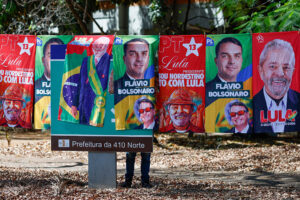
What Washington May Misread in Brazil’s Election
President Lula and Flávio Bolsonaro have more in common than meets the eye on key issues, including trade with China and critical minerals.