



MEXICO CITY—After almost two years in office, President Claudia Sheinbaum has significantly improved the Mexican state’s capacity to fight organized crime. This is arguably her biggest achievement, and the recent capture or elimination of criminal leaders are undeniable successes. In Sheinbaum’s second annual informe presidencial speech to the nation earlier this month, she underscored that since she took office, the daily average of intentional homicides has fallen 51%.
The figure compares September 2024 with July 2026, according to the government’s Secretariado Ejecutivo del Sistema Nacional de Seguridad Pública (SESNSP). Although the agency and INEGI, Mexico’s independent statistics institute, have methodological differences and report different figures, both sources point to a national decline in homicides.
Despite these advances, Mexico still faces significant challenges in addressing its broader crisis of violence. Extortion, disappearances and human trafficking—especially the forced recruitment of women, children and young men into criminal activities—are still rampant. For any solution to stick, it must address these problems head-on.
A new approach
Sheinbaum and her security secretary, Omar García Harfuch, have reworked the government’s crime-fighting priorities. They quietly converted former President Andrés Manuel López Obrador’s “hugs, not bullets” policy into a strategy of direct confrontation with organized crime. The government has strengthened the state’s intelligence apparatus, improved coordination among military, civil, local, and federal security agencies, and targeted “violence generators” and the “financial and logistical operators” of criminal groups.
At the same time, the administration opted to intensify collaboration and alignment with the United States and to increase arrests and seizures of arms, drugs, and money linked to criminal activities. In her September address, Sheinbaum also noted that this year, the daily average of “high-impact” crimes has fallen 54% compared to 2018. To their credit, independent scholars and think tanks generally agree on the significant reduction in violent crime, but they also point to potential statistical errors, mismanagement, and even manipulation.
The reduction in homicides and other violent crimes is good news for Mexico. The gradual strengthening of the state’s capabilities to recover lost ground—literally (as in territory) and figuratively (as in money and political power)—from criminal groups is also a positive development. Moreover, the relative success of the crime-fighting strategy has been key for foreign policy and national security purposes: It has helped contain President Donald Trump’s pressure and restrain the most radical members of the MAGA coalition, who have advocated for unilateral military action in Mexico.
Weak points
But Sheinbaum’s strategy has clear holes. From October 2024 to July 2026—Sheinbaum argued in her address—security forces arrested 63,000 individuals linked to criminal activities, seized 32,824 firearms and 519 tons of drugs, and destroyed 2,725 clandestine labs. This might be helpful for fighting organized crime, but not necessarily for tackling the broader problem of violence.
To start, arrests are not convictions. Since 2018, the ruling Morena party has aggressively broadened mandatory pretrial detention, sending defendants to prison while their investigations and trials unfold. Independent research estimates that around 102,000 Mexicans are incarcerated and waiting for their cases to be resolved. This suggests the state is struggling to provide due process and a fair trial, both critical to ensuring the right people are arrested. Meanwhile, civil society groups have shown that this automatic incarceration hits marginalized communities the hardest, and there is the risk that most of those found guilty are replaceable street-level operators, not criminal middle and upper management.
On the other hand, the focus on drug seizures and the destruction of clandestine labs does little to protect local communities from one of the most common and destructive types of violence they suffer: “criminal taxation.” As in many other parts of Latin America, extortion is now one of Mexico’s most persistent and rapidly growing crimes, affecting everyone from street vendors to major businesses.
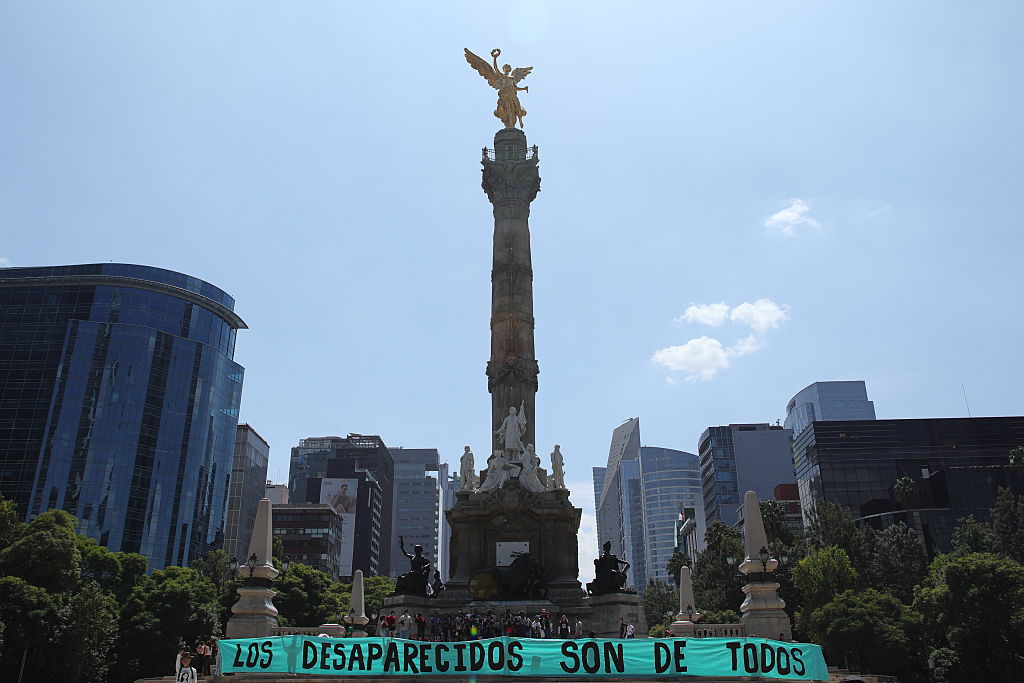
Disappearances also are not abating. Mexico now has more than 135,000 missing people. Recent research indicates that a growing share are those forcibly recruited by criminal organizations—as hitmen, sex workers, logistics operators and messengers, among other roles. Sheinbaum continues to downplay the scale of disappearances and forced labor in Mexico, and did not mention these issues in her presidential address.
These problems signal a key weakness of Sheinbaum’s security strategy: excessive centralization. The think tank México Evalúa has recognized the strategy’s merits, but warns that without stronger regional police forces and prosecutors’ offices—and without accounting for regional nuances in violent crime—it will be difficult to sustain the nationwide drop in violence. This matters especially now: Some states (Coahuila, Querétaro, Tlaxcala) are seeing sharp declines in violent crime, while others (Colima, Guerrero, Michoacán, Sinaloa) face intensifying or persistent violence. For residents of those states, the “national reduction” in violence may feel like little more than a statistical fiction.
A common objection to regionalizing security policy is that local police forces are institutionally weaker and more prone to corruption. But the federal government can take steps to strengthen and professionalize them, and it doesn’t have to cede leadership or oversight to tailor its strategy to each region.
Fragile success
Coahuila offers an often-overlooked success story. In the early 2010s, Los Zetas—likely the most violent criminal organization in Mexico’s history—controlled much of the state. The government’s pacification strategy, which largely worked, combined federal firepower with a sharply strengthened state police force that targeted the Zetas’ top leadership until the group’s economic base and command structure collapsed. Local authorities also struck a pact with the private sector against money laundering, funneling political contact with criminal groups through a small circle of designated interlocutors. The result was one of the most dramatic security turnarounds in Mexico’s recent history.
This kind of federal-state cooperation will be vital. But it demands somewhat cleaner local politics. So far, Sheinbaum and Morena have gone easy on officials suspected of ties to organized crime, prioritizing cohesion within the ruling coalition over confronting criminal groups’ political influence.
It appears that Sheinbaum is opting for a middle path: tightening the vetting process for candidates running for major elected offices in June 2027 to screen out figures with criminal ties, without purging the party outright. That’s probably not enough. As long as criminal groups’ political protection rackets—and the impunity they produce—remain intact, law enforcement will suffer.
Sheinbaum has made important strides, but it’s unclear whether she will take the steps needed to consolidate those gains and keep making progress. Much will depend on efforts to shore up and work with regional law enforcement and clean up the politics that shape it.
ABOUT THE AUTHOR

Jacques Coste
Reading Time: 4 minutesCoste is a columnist at Nexos and author of Derechos humanos y política en México (2022).

“El Mencho”’s Death Will Test Mexico’s Meager State
The perennially under-resourced government may struggle to contain spiraling violence following the demise of a cartel leader.