



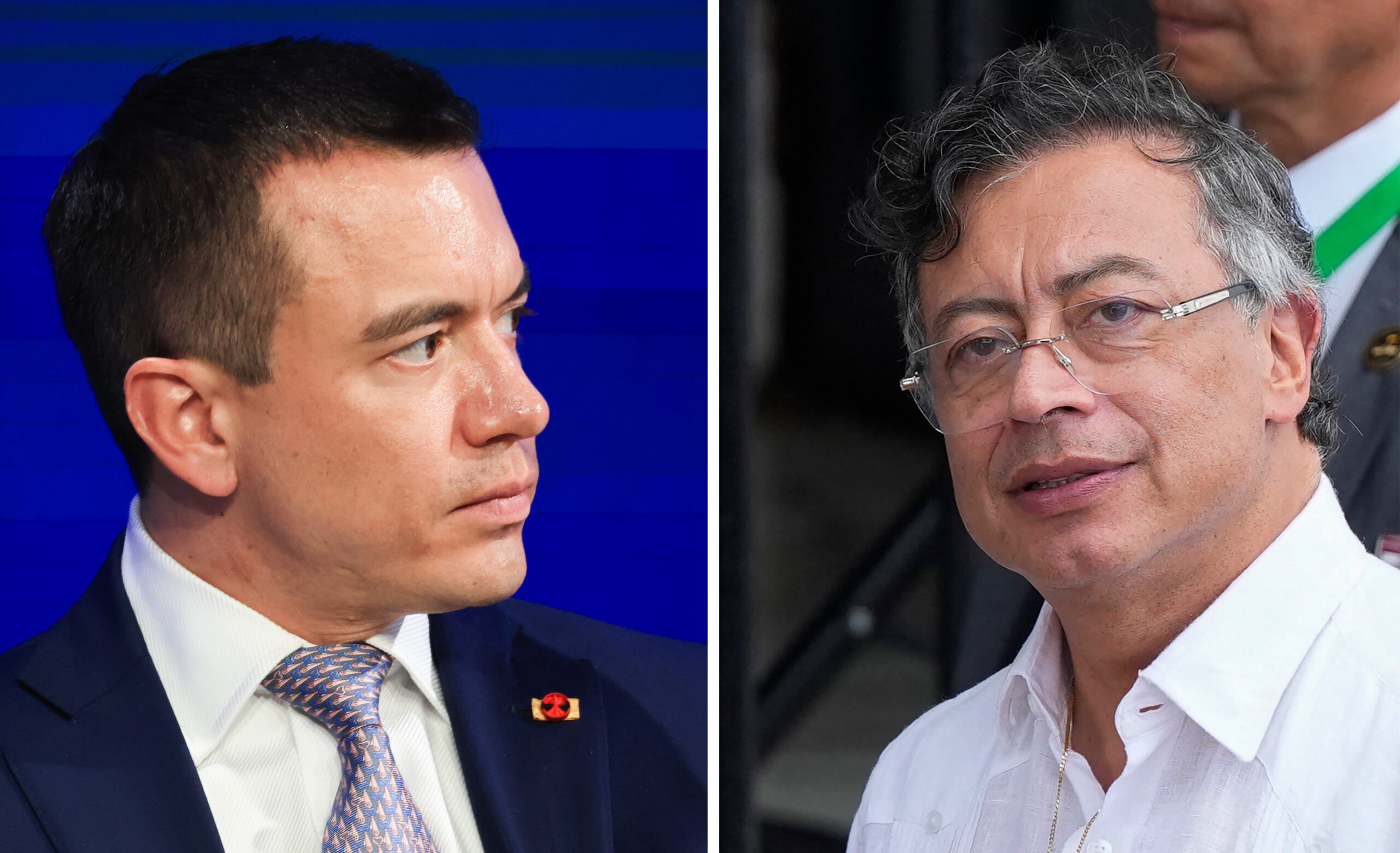
QUITO—At the Rumichaca International Bridge, the main artery connecting Ecuador and Colombia, there has been an “unusual, almost disquieting silence,” according to local media. This stillness is the result of a diplomatic rupture that has spiraled into a full-blown trade and energy war between the two countries. Since the last major bilateral crisis in 2008, the underlying tragedy remains the same: a border defined by cocaine, a relationship held hostage by the personal political calculations of presidents, and a region increasingly squeezed by the geopolitical ambitions of the United States.
The current crisis detonated on January 21, not with a bang, but with a tweet. From Davos, Ecuadorian President Daniel Noboa announced a 30% “security tariff” on Colombian imports, citing a “lack of reciprocity” from Bogotá in combating drug trafficking along a shared 600-kilometer border. Noboa’s move was a gamble, weaponizing trade and tying it to security policy. He argued that Colombian inaction was bleeding Ecuador dry, forcing Quito to bear the financial burden of a war against organized crime that originates next door.
The response from Colombian President Gustavo Petro was swift. Colombia not only imposed reciprocal tariffs on key Ecuadorian goods but also indefinitely suspended electricity exports to Ecuador. Given that Ecuador is already grappling with energy shortages, relying on Colombia for up to 10% of its power during droughts, this move makes the Ecuadorian grid even more vulnerable during the dry season between September and March. Noboa escalated the feud this week by increasing oil transportation fees at the OCP pipeline, though a minimum amount of Colombian oil travels that way.
For now, Colombia seems to have the upper hand: the trade relationship is more important to Ecuador’s economy than Colombia’s. But Washington, generally close with Noboa and cold toward Petro, is a key wild card, and both countries will ultimately suffer as their economies take a hit and the criminal groups at the heart of the conflict benefit from a breakdown in cooperation.
Déjà vu
To better understand this moment, one must look back to March 1, 2008, when the Colombian military, under right-wing President Álvaro Uribe, bombed a FARC encampment inside Ecuadorian territory, killing senior commander Raúl Reyes. Then, Ecuador’s left-wing President Rafael Correa severed diplomatic ties, denouncing a violation of sovereignty.
After 18 years, the political polarities at play have flipped—in 2008, Colombia was governed by the right (Uribe) and Ecuador by the left (Correa), while today, Colombia has its first leftist president in Petro, while Ecuador is led by the conservative Noboa. Yet the structural drivers of the conflict remain stubbornly consistent. Four throughlines stand out.
First, the core problem remains the cross-border cocaine trade. In 2008, the FARC used the porous border as a strategic rear guard. In 2026, the actors have mutated into criminal bands and FARC dissidents, but the dynamic holds: Ecuador has become the main transit hub for Colombian cocaine, and violence there has surged as groups fight for control of logistics corridors. Unfortunately, negotiations are now harder and military solutions more elusive. The FARC of 2008 was a politically motivated insurgency with a clear command structure. The “groups” operating on the border today are fragmented criminal enterprises focused on drug trafficking and illegal mining, lacking the ideological veneer of the past.
Second, the shadow of the U.S. looms large. In 2008, Uribe’s confidence was buttressed by Washington’s support through “Plan Colombia,” and the U.S. backed Bogotá against Quito’s complaints of violations of sovereignty. Today’s “Trump Doctrine” hardly cares about sovereignty and has been pressuring Petro while backing Ecuador. Noboa, an American-born businessman, has positioned himself as a key ally in Washington’s renewed war on drugs, seeking to leverage U.S. support to offset his domestic vulnerabilities. Petro, meanwhile, is increasingly isolated by the U.S.’s growing crop of right-leaning allies.
Third, the economic asymmetry remains a critical vulnerability for Quito. The trade relationship has always been more significant for Ecuador’s economy than Colombia’s, and dollarization in Ecuador is particularly sensitive to tariffs because currency devaluation is not an option to absorb external shocks. Also, Ecuador’s dependence on the Colombian electricity grid during dry seasons provides Bogotá with additional leverage.
Finally, we see the subordination of state policy to the personal grievances and political needs of the countries’ leaders. In 2008, the Uribe-Correa animosity was palpable. Today, the friction between Petro and Noboa is toxic. Their relationship has deteriorated over Petro’s defense of imprisoned former Ecuadorian Vice President Jorge Glas and spats over the legitimacy of Noboa’s reelection.
Both are using the border crisis to deflect blame and rally nationalist sentiment at a time when their domestic standing is shaky. Noboa’s approval ratings have eroded following a lost referendum and a failure to deliver on security promises. His imposition of tariffs is seen as a maneuver to project strength while deflecting blame. Petro, meanwhile, faces his own governance crises and is entering the twilight of his term ahead of the May elections.
The road ahead
Today’s weapons of choice are economic: tariffs and kilowatts. While less visually dramatic than military mobilization, the impact on citizens’ daily lives is more immediate and damaging. The outlook is precarious. With Colombia facing a potential change in the election this year, Petro has little political incentive to offer concessions to a right-wing neighbor. Should Noboa’s gamble fail to curb the violence—which remains at record levels—he may escalate the external enemy narrative, deepening the freeze in relations. The risk is that the “security tariff” becomes a permanent fixture, undermining formal trade, encouraging contraband, and preventing potential cooperation on organized crime.
This trajectory can eventually be averted if Noboa reverses course under domestic political pressure, a new right-wing government in Colombia mends relations, or President Trump forces Petro’s hand. After all, under the “Donroe Doctrine,” the U.S. is expected to continue using Ecuador as a wedge to pressure Colombia on narcotics and migration issues.
For now, what Ecuador might require on security remains uncertain. Ironically, the environmental dispute has shifted; for years, Ecuador criticized Colombia’s use of glyphosate aerial spraying. Now, amid rising violence, it is Ecuador calling for “firm action” and clear results, a stance that could lead Quito to demand the very eradication tactics it once sued Colombia to stop.
Ultimately, this conflict highlights that when two presidents struggle to lead their countries, the border often becomes a stage for political drama. However, as trade through Rumichaca drops, it’s clear that a tariff war and power outages between interconnected neighbors lead to no winners.
ABOUT THE AUTHOR

Sebastián Hurtado
Reading Time: 4 minutesHurtado is founder and president of PRóFITAS, a leading political risk consultancy based in Quito.