


BOGOTÁ—Last month in Colombia’s capital, I met a retiree, Hugo, who had spent much of his career in the Ministry of Communications, including under ex-President Álvaro Uribe. He and his wife now lived on his modest public pension, supplemented by occasional jobs.
Hugo said he was neither right nor left. He did not vote for President Gustavo Petro in 2022. But he had become a staunch supporter since, seeing how Petro tried to help “people who never had anything” and older adults of modest means like himself. True, Petro had left much unaccomplished. But his presidency had been good for the country because it had made its inequalities impossible to ignore, he said.
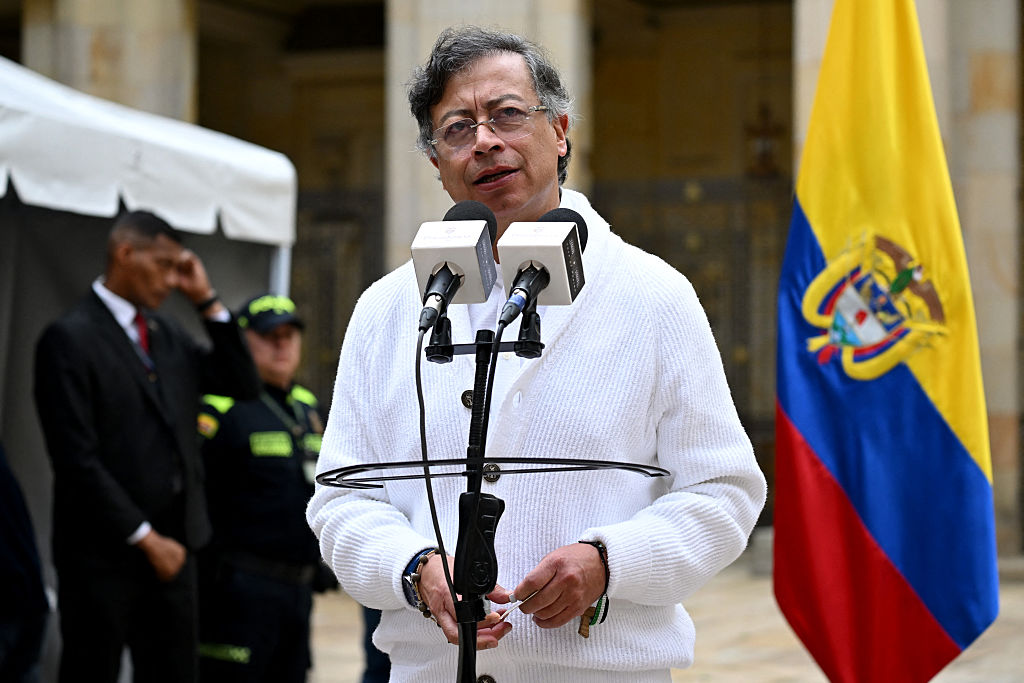
On my visit to Colombia, this was what struck me most: Amid a regional turn to the right, no one was counting out the left in the May 31 presidential election. Petro, without doing much to change Colombia’s deep regional and class divides, has focused public attention on them like no previous president, to the apparent satisfaction of many voters.
That shift benefits his preferred successor and leftist candidate, Iván Cepeda. It also poses a hurdle for the opposition, which has clear messages on security, but not on the yawning gaps between the country’s core and neglected regions, or between its haves and have-nots.
After years spent struggling to translate his visions into policy, Petro has lately had more success—and it shows in the polls. In December, he decreed a nearly 23% minimum wage hike to about $470 USD/month, the largest in decades, to “democratize wealth so that working people, who make up the majority of the Colombian population, can live better.”
The hike benefits 2.5 million workers, about a tenth of the workforce. Critics warn the decision could damage the creation of formal jobs and produce other negative consequences in the medium term. Nevertheless, this and other recent moves, such as increasing the pay of rank-and-file soldiers, has contributed to something rarely seen in Latin America: a significant polling rebound for a lame duck president.
Petro’s approval has recently surged. It now approaches 50% according to one poll, double his rating of eighteen months ago.
Cepeda seems to be benefiting as well. A March poll by Spanish consulting firm GAD3 had him beating right-wing candidate Abelardo De la Espriella by a 9-point margin in a hypothetical run-off, and in a technical tie with conservative Paloma Valencia, who has been rising since winning a March 8 opposition primary. This is all the more remarkable because of Cepeda’s pronounced electoral vulnerabilities: his lack of Petro’s charisma or oratory, his austere persona and flat campaign videos, and his reputation as an ideological hardliner, liable to scare some moderates Petro won in 2022.
A “blind and myopic” establishment
What, then, explains the Colombian left’s relative strength? Certainly not the past few years’ headlines: investigations into Petro’s son for allegedly taking narco-campaign cash, a healthcare reform that went wrong , and surging illegal armed group recruitment in the countryside, to name just three.
Materially, Petro has not yet radically transformed the lives of his supporters either; not on the scale of an AMLO, for instance, who more than doubled Mexico’s real minimum wage nationwide, ushering 13.4 million Mexicans out of poverty. Welfare improvements under Petro have been modest. Multidimensional poverty has fallen more slowly than in past years, and the country’s Gini coefficient, a measure of inequality, has barely budged. Colombians have left monetary poverty at a similar annual rate to his predecessors—about 2.6 million in total, thanks as much or more to a post-pandemic recovery than government policy.
The distribution of wealth, opportunity, land, and infrastructure remains much as it was before he took office—exceptionally skewed, even by Latin American standards.
But what Petro has redistributed adeptly is recognition. Both supporters and critics I spoke with agreed on this: this president has spoken about—and more importantly, to—parts of the country and population that felt unheard and unseen before. He has crafted a new national story where those people and places matter. And it’s not at all clear his opponents know how to respond.
“Elites in the core of Colombia—the four big cities, and a few medium-sized ones—were between blind and myopic about the reality of such a large country,” said Juan Ricardo Ortega, a former director of Colombia’s tax and customs authority. “The core constitutes one world, where we built infrastructure, electricity, and education.” Beyond it lies “a disastrous periphery” of unpayable electricity bills, failed hospitals, and entrenched family clans. Just like his predecessors, Petro allied with many of those clans to win, and reinforced underlying structures. But “he has had the intelligence to evoke these injustices.”
Eighty percent of Colombian respondents to the 2024 Latinobarometro survey agreed that the country is governed by “a few powerful groups in their own interest.” Petro speaks to that belief. So does Cepeda.
But rhetoric isn’t the only reason the left could still win. Petro’s social policies—though far less ambitious or transformational than what he promised—have mattered, too.
Outliers in Latin America’s right turn?
Take public spending. The Petro government has spread a historically large budget far and wide, reaching new places and new hands. Direct targeted investment in municipalities has jumped from 6% to 41% of total public investment. Recipient municipalities rose from 210 under Iván Duque to 1,036 under Petro, with impoverished, disconnected departments like La Guajira ranking among the top beneficiaries. The projects funded are mostly short-term, not transformational infrastructure, in places that sometimes lack the administrative capacity to spend efficiently. But to much of Petro’s base, it looks like recognition no one else has offered.
Something similar is happening on the individual level, too: new forms of state support that are small in absolute terms, but big for the people receiving them. Not a social welfare state, but gestures that say “we see you.”
For example, Petro committed to extending formal employment status, severance, health and pension coverage to Colombia’s roughly 40,000 madres comunitarias—women who run at-home daycare centers in poor neighborhoods—and delivered monthly payments to over 5,500 families who pledged to conserve Amazon rainforest. In January, on the eve of a pre-election contracting ban, the national government signed 85,000 new individual service contracts—essentially, short-term public jobs with government agencies. Petro’s critics, with some justification, call the latter clientelism. But, again, it is not yet clear they have a competing message for the beneficiaries.
Valencia and her running mate, center-right technocrat Juan Daniel Oviedo—the dark horse success of the opposition primary—have real strengths. They hold a clear advantage in Antioquia and much of the center of the country, minus Bogotá. Valencia has doubled down on security: undoubtedly Petro’s most serious failing, though one that paradoxically falls heaviest on rural areas in regions still largely loyal to him. In the Sierra Nevada de Santa Marta—the Caribbean coastal mountain range currently fought over by armed groups that grew stronger during and despite Petro’s “total peace” initiative—many people I met said they still planned to vote for the left, because they identified with Petro’s project.
The election seems particularly unpredictable, with several question marks including reports the U.S. Justice Department is investigating possible links between Petro and drug traffickers. (Petro has denied any wrongdoing.) Yet even if Colombia does ultimately join the region’s rightward turn, the base Petro has cohered—less purely around himself than around the issues of class and regional inequalities—will likely persist.
Alongside Petro’s considerable negative legacies—reduced military and police capacity, and the petroburguesía, as a new cohort of corrupt government officials are now called—one positive one will live on: Colombia’s inequalities will from now on be harder for politicians to ignore.
This is not to say the left will dominate politics forever. Colombia and Mexico are outliers in a sense: because the left never reached national office there during the first “left turn” of the 2000s, presidents talking frontally about the politics of class and regional inequalities are still, in some ways, new. In another electoral cycle or two, their resonance could wane, supplanted by other issues, much as has happened in Brazil.
But at a time when the Latin American left can appear like it is heading towards the brink of some kind of mass extinction event, Colombia offers reason to reconsider. In a region still so marked by the gap between rich and poor, the issue that has always animated the left has not gone anywhere. In Colombia, it may still define the coming election.
ABOUT THE AUTHOR

Will Freeman
Reading Time: 5 minutesFreeman, Ph.D., is a fellow for Latin America studies at the Council on Foreign Relations.

Colombia: Meet the Candidates 2026
Violence and corruption top voter concerns ahead of the first round of presidential elections on May 31.
Colombia: A 2026 Snapshot
AQ tracks key indicators and political and economic trends to watch in 2026.