


Two decades ago, while serving at the U.S. Embassy in Nicaragua, we developed an informal verb for one of the tools we were using against corruption and attacks on democratic institutions: “desvisar”. Roughly translated, it meant to take away someone’s U.S. visa. Before long, those who had lost their visas became known, at least among some of us, as “desvisados.”
The expression carried humor, but the policy was not trivial. From 2005 to 2007, we used visa restrictions in Nicaragua unusually aggressively. The experience persuaded me that denying access to the U.S. can be one of the more effective—and underappreciated—tools available to American diplomacy.
That lesson is newly relevant. At the end of last month, the Trump administration revoked the visas of 27 officials from Bolivia, Colombia, Ecuador and Peru, citing corruption, narcotics trafficking and conduct that undermines democratic governments. But the administration’s use of visa power is reaching much further.
In Mexico, Andrés Manuel López Beltrán, son of former President Andrés Manuel López Obrador, said in August that Washington had revoked his visa; the U.S. government has not publicly disclosed the reason. Baja California Governor Marina del Pilar Ávila and her then-husband also lost their visas last year. In Brazil, Washington revoked the visa of Ambassador Maria Luiza Ribeiro Viotti in August amid a diplomatic dispute over Brazil’s delay in approving President Trump’s nominee as ambassador and its denial of visas to U.S. diplomats. A year earlier, Secretary of State Marco Rubio revoked visas for Supreme Court Justice Alexandre de Moraes, unspecified judicial allies and immediate family members over what Rubio called a campaign of censorship and political persecution.
The policy has also reached strategic competition with China. In Argentina, executives of the Neuquén electricity cooperative CALF said a U.S. Embassy official warned that visas could be restricted or revoked if the cooperative proceeded with a Huawei-related project; the U.S. ambassador subsequently defended the pressure as a national-security matter. In Chile, the State Department revoked visas for three government officials and their immediate families, accusing them of compromising critical telecommunications infrastructure and regional security.
Taken together, these cases show that “desvisar” is not one policy but a tool. It can be used against alleged corruption or organized crime, to answer diplomatic retaliation, to protect what Washington defines as national-security interests, or to influence choices involving Chinese technology. That breadth is precisely why the tool deserves attention.
The big picture
Visa restrictions occupy an unusual space in foreign policy. They can carry significant consequences, but they are not criminal sanctions. A U.S. decision to deny or revoke a visa does not establish that the person committed a crime, and another country should not treat an American immigration decision as a substitute for its own judicial process. The U.S. controls admission to its territory; other governments remain responsible for investigating violations of their own laws.
Bolivia offers a timely example. Washington publicly designated Prosecutor General Roger Mariaca for what it describes as significant corruption involving narcotics traffickers. Mariaca denied the allegations, and Bolivian authorities have sought the information underlying the U.S. action. That is the proper response: neither accepting Washington’s accusation as a verdict nor dismissing it merely because it originated abroad. Yet, days ago, Mariaca was arrested for allegedly money laundering and drug trafficking.
The political effect of a visa restriction can extend far beyond the border. In Nicaragua, officials who lost their visas sometimes announced that they did not care. Perhaps some genuinely did not. But for many members of Latin America’s political and economic elites, access to the U.S. can involve children at American universities, relatives, business networks, property, medical treatment, and social status. Losing that access can impose a meaningful personal and reputational cost even when no financial asset has been frozen and no criminal charge filed.
It also sends a signal to people who have not yet been sanctioned. That deterrent effect is difficult to quantify, but in Nicaragua it was impossible to miss.
For years, I argued that the policy could sometimes be made more effective by extending restrictions to immediate family members. That argument requires care. A spouse or child is not culpable merely because a relative engaged in corruption. The rationale is leverage, not inherited guilt. An official may be prepared to lose his own ability to enter the U.S. and even turn the sanction into a display of nationalist defiance. The calculation may change when the consequences affect the family’s access, too.
Yet effectiveness is not the same thing as legitimacy. The current range of cases demonstrates why evidence, consistency and purpose matter. A visa tool used against corruption can also be used in a diplomatic quarrel or a geopolitical contest. Governments therefore should not assume that Washington’s stated rationale is necessarily the whole story, and observers should ask who is being targeted, on what evidence, and whether comparable cases are treated comparably.
Changing incentives
Visa decisions are often opaque. Confidentiality rules can prevent the public from knowing the evidence behind a revocation. The resulting uncertainty may help policymakers, but it can also invite speculation and allegations of political selectivity.
The U.S. has limited ability to reform other countries’ institutions, and even less ability to substitute for them. But it can decide who enters its territory. Used carefully, visa restrictions can change incentives, impose costs where impunity has prevailed, and prompt domestic institutions to investigate allegations they might otherwise ignore.
Twenty years ago in Nicaragua, we learned that a visa could be more than a travel document. The “desvisados” are back. This time, the real test will be not simply who loses access to the U.S., but whether Washington applies the tool consistently—and whether Latin American institutions respond to serious allegations with evidence, independence, and due process.
ABOUT THE AUTHOR
Steven E. Hendrix
Reading Time: 4 minutesHendrix is chief executive of Hendrix LLC and senior research fellow at DePaul University College of Law. He is a former U.S. diplomat and senior USAID official, and is the author of The New Nicaragua: Lessons in Development, Democracy and Nation-building for the United States.
What Washington May Misread in Brazil’s Election
President Lula and Flávio Bolsonaro have more in common than meets the eye on key issues, including trade with China and critical minerals.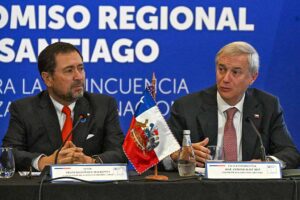
How Chile Can Turn U.S.-China Rivalry into Negotiating Power
Leveraging strategic resources, screening investments, and diversifying partners can strengthen Chile’s position.