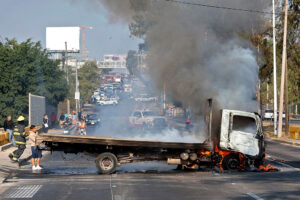



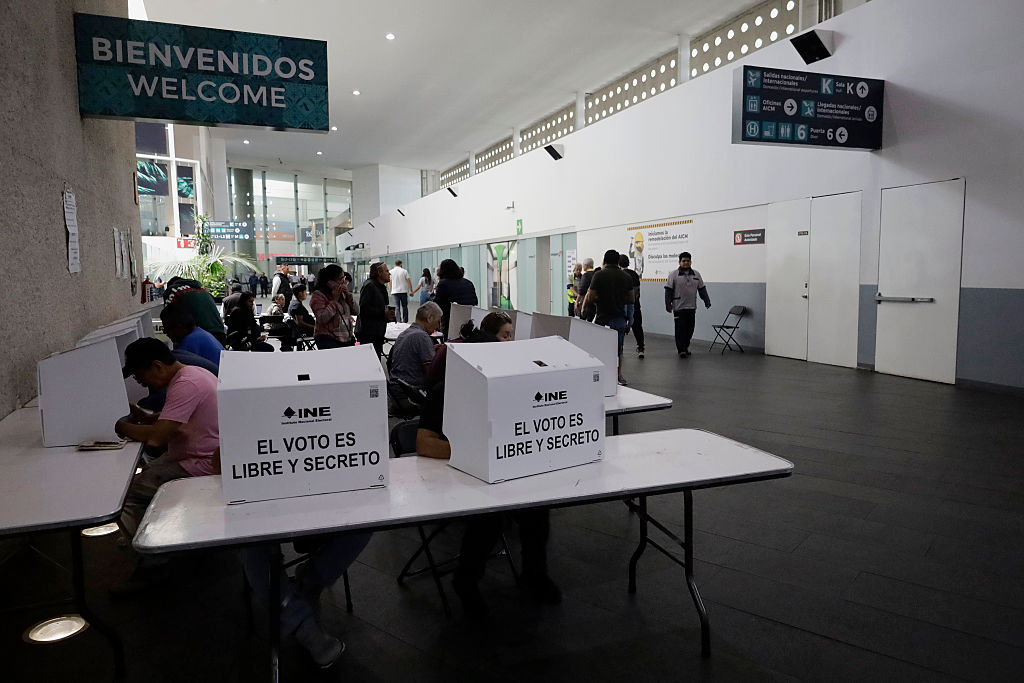
As global audiences focused during the summer on the North American World Cup, or the conflicts raging in the Persian Gulf and Ukraine, many missed a troubling development taking place in Mexico. In June, President Claudia Sheinbaum’s ruling Morena party ignored widespread concerns and hastily passed a bill in Congress that could annul any election—legislative, gubernatorial or presidential—if the government decides there was “foreign interference.”
This is particularly significant as Mexico heads toward a critical midterm election in 2027, its next presidential election in 2030, and as it continues its downward slide away from a liberal democracy of checks and balances by degrading democratic institutions and guardrails, ensuring control over the judiciary, and frequently vilifying journalists and media outlets.
The bill in question, one of the most retrograde pieces of legislation in Mexico’s young democratic history that began in the mid-1990s, is part of a familiar playbook, perfected in places like Hungary, Venezuela or Nicaragua. First you dress up democratic backsliding in the language of sovereignty and anti-imperialism. Then you make legitimate external scrutiny or opinion illegal. Finally, you use that law selectively, à la carte, whenever needed.
What counts as “foreign interference” according to this new law? Virtually anything. Policies or statements by a foreign government, or a revoked visa; an editorial, an article or an investigative story by an international media outlet on corruption or violence in Mexico, or even on its internal politics; a social media post by a foreign leader or by a member of the U.S. Congress, the European Parliament or even an international NGO; a UN report on disappearances in Mexico. All of it can now be used as grounds to claim there’s a foreign conspiracy afoot. This bill becomes a blank check, and Morena holds the pen.
The law doesn’t prevent actual foreign interference. It simply hands the government a veto over election outcomes it doesn’t like. And therein lies the problem. The elections body that is set to decide whether “interference” occurred has been deprived of resources, leadership and autonomy by the previous administration of Andrés Manuel López Obrador, with Morena chipping away at the remaining independence of Mexico’s electoral institutions. Moreover, the electoral referees are now handpicked directly or indirectly by Morena, which seems to be pursuing a return to a single-party hegemonic ruling system like the one Mexico had for 70-plus years in the previous century. Paradoxically, the main allegations of foreign interference in Mexico’s elections came in 2006, when López Obrador, despite his emphatic denials, was accused of receiving financial support for his first unsuccessful presidential campaign from then-Venezuelan President Hugo Chávez.
But the gravest irony of all is that the bill is wilfully blind to the real interference plaguing recent Mexican elections—not a foreign government or a foreign media outlet, but organized crime. According to some reports, in Mexico’s 2021 midterm elections, criminal organizations, particularly in the northern states of Sinaloa and Tamaulipas, handpicked candidates, intimidated or whipped voters, and in some cases effectively ran the ballot.
That’s what ultimately led this past April to U.S. indictments against 10 current and former public officials in Sinaloa linked to transnational criminal organization based in that state, including the now defenestrated and twice-on-leave governor, one of its federal senators and the mayor of the state’s capital city, Culiacán. Morena’s bill has nothing to say about organized crime, not only because that threat doesn’t serve the narrative, but because in some cases, it may be rather too close to home.
The target of the law is obvious enough: the United States, and indeed the Mexico-U.S. bilateral relationship itself. Any comment from Washington, from any governmental or non-state actor—on rule of law, fentanyl, violence and trafficking, press freedom, migration, human rights or a level playing field for U.S. businesses—can now be construed as “interference” or “intervention.”
Internal Morena party dynamics also appear to be at work. Public Security Secretary Omar García Harfuch has overseen intelligence-driven operations, culminating in the takedown of drug kingpin Nemesio Oseguera “El Mencho.” This tougher line on security has marked Sheinbaum’s clearest and most welcome break from López Obrador’s much softer approach, and helped ease relations with Washington. However, it has also made García Harfuch a lightning rod for hardliners within Morena and the former president’s inner circle who see his ascent and collaboration with the United States as a repudiation of the movement’s founding creed and nationalistic stance. (López Obrador in fact blocked his attempt to become Morena’s candidate for mayor of Mexico City in 2024.) Given that dynamic, the law paradoxically could also be used to try and scupper the secretary’s political ambitions going into the Morena presidential nominating process.
And with the United States-Mexico-Canada trade agreement on shaky and unpredictable ground, this law is only likely to deepen chauvinistic and demagogic nationalism, exacerbate tensions and open up greater vulnerabilities in ongoing negotiations.
Since assuming office in 2024, Sheinbaum has prioritized the protection and vindication of her predecessor and mentor’s legacy and stalwarts over the national interest and her ability to govern on her own terms. That has a cost. Indeed, Morenashould not be allowed to achieve what Hungarian sociologist and political theorist Balint Magyar calls “autocratic breakthrough”: the point after which it’s impossible to unseat an autocrat using elections. Mexico deserves better. So does the democratic community that stood by it as it transitioned to a fuller democracy between 1997 and 2018. This bill needs to be challenged—by Mexicans, of course, in the courts and in the streets, but also in the court of international opinion. Silence or turning a blind eye should not be an option.
ABOUT THE AUTHOR
Arturo Sarukhan
Reading Time: 4 minutes
Sarukhan is an international consultant based in Washington, D.C. A board member of the Americas Society, he is the former Mexican ambassador to the U.S. (2007-13) and a career diplomat for more than 20 years. He served as Mexican consul general in New York and chief of policy planning at the Mexican foreign ministry, among other posts.
Mexico’s Weak Opposition—and Morena’s Hidden Fragility
Next year’s midterm elections might alter the nation’s political map, writes an expert.
USMCA and the Politics of Permanent Leverage
The U.S. wants to keep the review of the trade agreement open and has little incentive for a final deal, an expert writes.
AQ Podcast | The Mexico-U.S. Relationship’s Most Delicate Phase
What recent security concerns and a looming USMCA review mean for Sheinbaum and for Mexico