



MEXICO CITY—Without much fanfare, U.S. and Mexican trade negotiators concluded a third round of bilateral USMCA talks in this city days ago. While progress was made on some issues, contentious topics such as auto industry rules of origin and nondiscriminatory access to Mexico’s electricity market are still sticking points that will be discussed in a new round scheduled for September in Washington.
Even as Mexico’s president, Claudia Sheinbaum, said on Friday that she had a “very good meeting” with the U.S. Trade Representative, Jamieson Greer, the reality points to a complex path for future negotiations where the parties involved will need to adjust to a new reality of constant and permanent leverage.
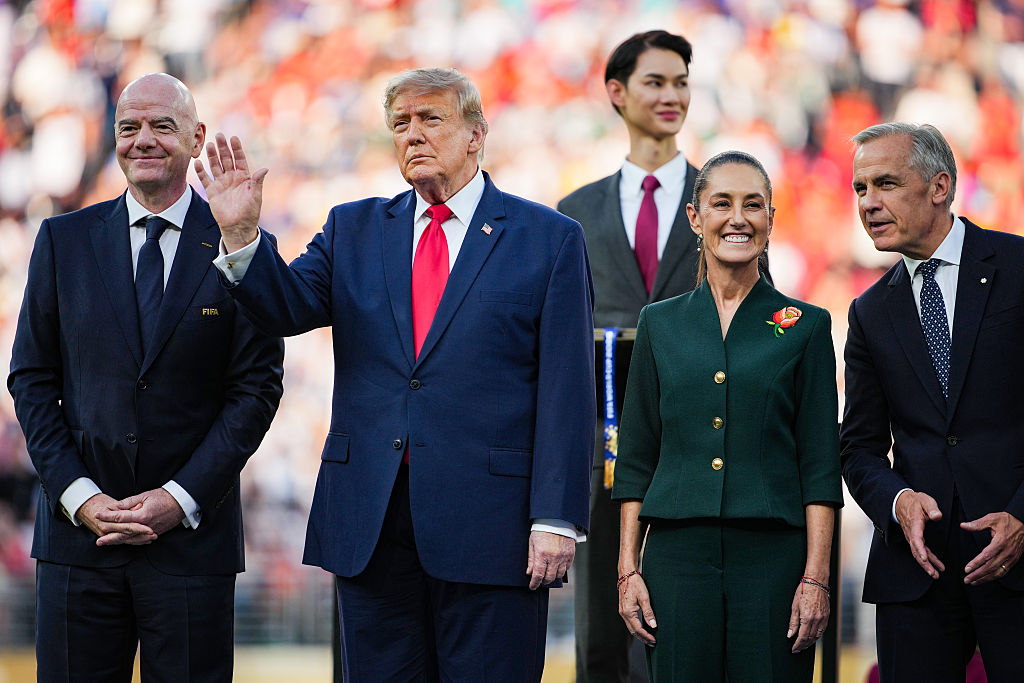
For decades, North American diplomacy sought to reduce friction among partners. Now, however, dialogue increasingly coexists with pressure. This is not incidental, but rather reflects today’s zeitgeist. Consider the closing ceremony of the FIFA World Cup. U.S. President Donald Trump stood alongside Mexico’s Sheinbaum and Canada’s Prime Minister Mark Carney. Three North American leaders, sharing the stage at the biggest sporting event ever jointly hosted by their countries, posed together before a global audience.
The image was meant to project unity, yet within hours, Washington announced a new 50% tariff on a broad range of Canadian exports. This made it even more evident that Canada is not participating in the trade talks of a de facto integrated North American market.
Mexico, too, received its own reminder. As Ismael “El Mayo” Zambada was sentenced to life in prison, DEA Administrator Terry Cole declared that the conviction was “only the beginning,” pledging to continue pursuing not only Mexican cartel leaders but also the corrupt officials who enable them.
These decisions underscore not only a new era but also a new paradigm for bringing your counterpart to terms. During more than two decades of working with U.S. officials under Republican and Democratic administrations alike, I had never encountered quite the same sense of entitlement that I experienced during a recent visit to Washington. It was not hostility. It was something subtler—and perhaps more consequential. Conversations increasingly reflected the assumption that the U.S. sets the terms while its partners adjust accordingly. The language was less that of allies pursuing common interests than of a power convinced that its market and its geopolitical weight entitle it to define the rules. That shift helps explain the current review of the USMCA.
U.S. Trade Representative Greer recently said he hopes to present President Trump and the other North American leaders with proposals by the end of the year. More revealing than the timeline, however, was the framework: one arrangement with Canada and another with Mexico. Washington views North America not as a single trilateral negotiation but as two distinct bilateral relationships, each governed by different political calculations.
The relationship with Canada has become noticeably sour. Mexico, by contrast, is still viewed as a partner worth engaging—not because disagreements have disappeared, but because Washington believes progress remains possible.
Washington’s new objective
So, what is the ultimate goal of the new Washington? The objective is not simply to secure concessions. It is to preserve the leverage that makes future concessions easier to extract. That distinction matters.
Some observers expect the USMCA review to conclude next year. That remains possible. Yet Washington’s political logic increasingly points in a different direction. For an administration that treats leverage as a strategic asset, there is little incentive to rush toward a final and conclusive deal.
Keeping the review open preserves flexibility and allows the U.S. to connect trade negotiations to an expanding range of concerns—from organized crime, fentanyl trafficking and migration, to concerns about Chinese companies seeking to free-ride on the USMCA,, water deliveries, energy policy and customs enforcement. If a comprehensive agreement is eventually reached, it may prove more politically valuable toward the end of President Trump’s term than at the beginning.
This ability to broaden the negotiating agenda rests on a deeper reality: the structural asymmetry of the U.S.-Mexico relationship. As long as access to the world’s largest consumer market remains indispensable for Mexico, Washington will retain extraordinary leverage well beyond trade itself.
Trade is no longer the only channel through which that leverage is exercised. Investigations into alleged links between Mexican public officials and organized crime have emerged as an additional source of pressure. Because such probes carry enormous political costs for the governing party, they have become an especially powerful instrument of leverage in the broader bilateral relationship.
The dynamic of concessions
The combination of economic dependence and political vulnerability helps explain Mexico’s increasingly narrow room for maneuver. Geography, infrastructure and three decades of North American integration have produced one of the world’s most sophisticated manufacturing ecosystems. Intermediate goods cross the border multiple times before becoming finished products. Supply chains and investment are deeply intertwined. There is no realistic substitute for the U.S. market in the foreseeable future, and political rhetoric cannot alter that fact.
Not every concession extracted by Washington represents a loss for Mexico. Some coincide with actions that Mexico should pursue regardless of U.S. pressure. Dismantling the links between organized crime and public officials is not simply an American priority; it is essential to strengthening the Mexican state itself.
Other demands, by contrast, deserve far greater scrutiny. Measures that unnecessarily constrain Mexico’s ability to shape its own industrial, technological or regulatory policies—or that impose trade disciplines so restrictive that they undermine the country’s long-term competitiveness—would raise legitimate concerns about Mexico’s national interest. The challenge, therefore, is not to resist every concession, but to distinguish between those that strengthen Mexico and those that unnecessarily limit its future room for maneuver.
That distinction becomes easier to make once Washington’s negotiating philosophy is clearly understood. One phrase I heard in Washington summarized the White House mindset with striking clarity: with Mexico if possible, without Mexico if necessary. It captures a negotiating philosophy in which cooperation is preferred, but leverage is preserved.
The World Cup photograph showed three leaders standing together. What followed demonstrated something far more consequential and revealed a broader strategic logic: Leverage is treated as a strategic asset—not merely because it produces concessions today, but because it makes the next concession easier to obtain. That may prove to be one of the defining principles of North American relations during these Trump years.
ABOUT THE AUTHOR

Brenda Estefan
Reading Time: 4 minutesEstefan is a professor at IPADE Business School in Mexico City and a columnist at Reforma, Mexico’s leading newspaper.

Q&A: Brenda Estefan on USMCA and U.S.-Mexico Ties
An expert dissects the bilateral relationship ahead of the July 1 trade agreement review.
AQ Podcast | The Mexico-U.S. Relationship’s Most Delicate Phase
What recent security concerns and a looming USMCA review mean for Sheinbaum and for Mexico
Getting the China Dimension of USMCA Right
North America would benefit from three decisions that could cement the region’s security and competitiveness for years to come, an expert writes.