



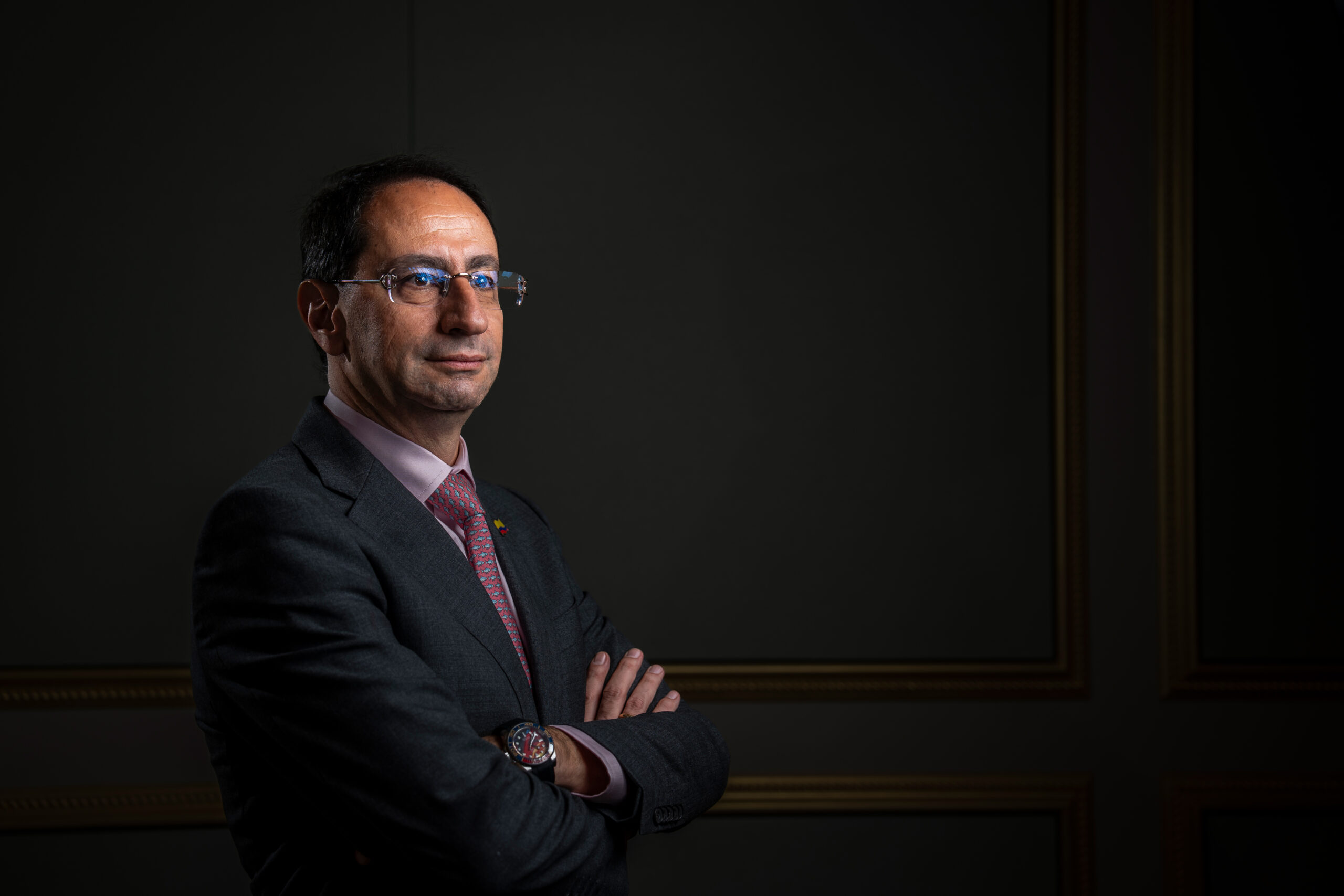
BOGOTÁ – Six months ago, José Manuel Restrepo never imagined that politics would once again propel him to Colombia’s center stage. About to be sworn in as the new vice president on August 7, he says that some days he wakes up thinking that it is all a dream: “Life is full of surprises.”
In February, the soft-spoken 56-year-old economist was still the head of EIA University, a prestigious private nonprofit institution on the outskirts of Medellín, Colombia’s second-largest city. Now, he’s emerging as one of the most important figures in Aberlardo De La Espriella’s government, with enormous influence over matters ranging from international affairs to economic management.
Restrepo’s resume stands out in the incoming administration in which the president and several ministers have never held public office before. During Iván Duque’s administration (2018-2022), Restrepo served first as Minister of Trade and later as Minister of Finance, when the country was in the midst of a complex national strike. He received high marks for helping to defuse the crisis then.
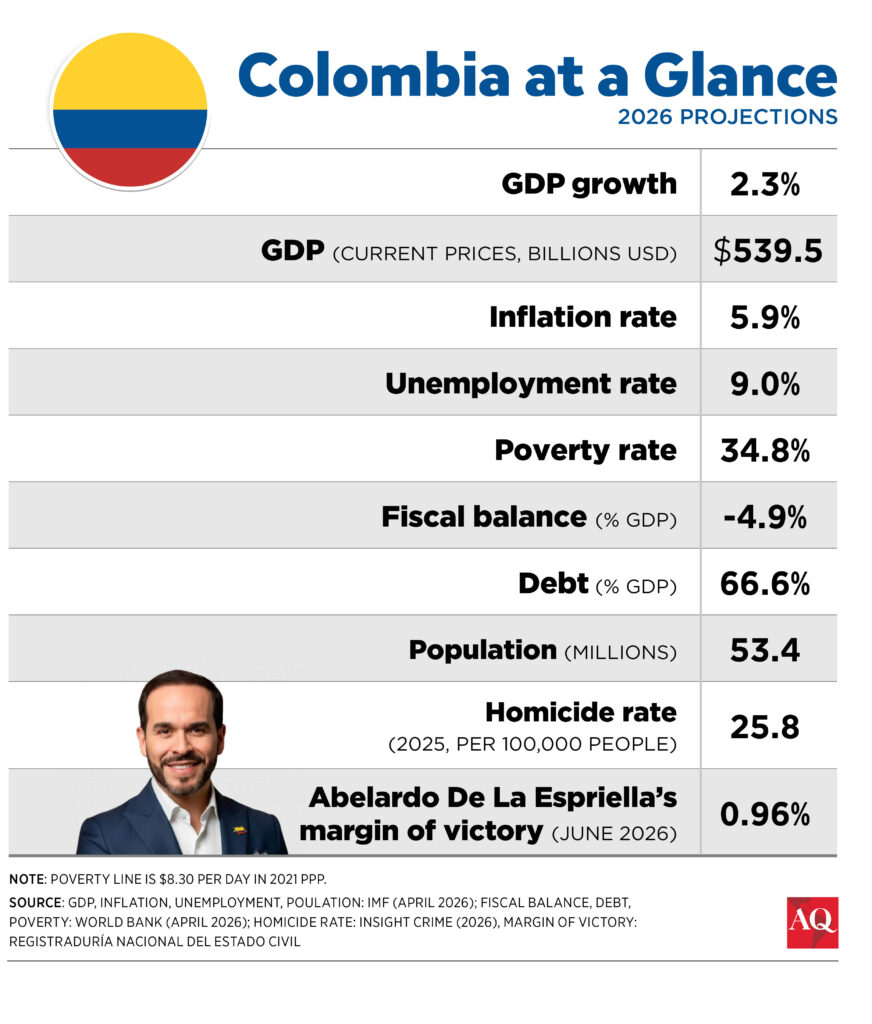
For today’s Colombia, Restrepo will need to draw on those lessons. President-elect De La Espriella and Restrepo won the June 21 runoff election with just 49.7% of the vote, narrowly beating leftist candidate Iván Cepeda. The victory, contested by Cepeda and the outgoing president Gustavo Petro, gives the new government limited political capital in a very polarized nation.
“He comes across as a nice person who is able to talk openly to friends and foes,” says Bruce MacMaster, the head of the influential National Association of Entrepreneurs (ANDI). “His adversaries recognize that Restrepo always listens, is affable, and uses reason instead of force to win an argument,” MacMaster told AQ.
Racing against the odds
Restrepo recalls that he met De La Espriella in mid-February in Bogotá after seeing him briefly just a couple of times before. “We spoke at length about economic matters and found that we shared the same views on many issues; we also laughed, told stories about our families,” Restrepo told AQ in a recent interview.
On March 9, he received an invitation to have dinner with the candidate in Barranquilla and was asked to bring his wife. One day later, on the eve of the legislative elections, De La Espriella announced his running mate decision. “He will be a kind of Marco Rubio during my government, in charge of many things,” the president-elect said that day.
During the campaign, a popular meme said: “Vote for José Manuel Restrepo… and his Presidential running mate.” Indeed, some analysts believe his serious demeanor helped balance the bombastic De la Espriella. “Some of (Restrepo’s) strong points are that he knows how the state works, never had a scandal, is methodical and connects with the institutions,” political journalist Diana Calderón told AQ.
After winning the election, Restrepo kept a high profile. He led a mission to Washington to anchor diplomatic ties with the Trump administration, multilateral organizations such as the IMF, and went to the inauguration of Keiko Fujimori in Peru at the end of July.
Restrepo is expected to become Colombia’s international face at least as the new government takes the reins. De La Espriella has reaffirmed his promise to remain in Colombia throughout his term, and recently announced he’ll be closing 14 embassies and consulates and cutting ties with Cuba and Nicaragua. He also plans to be most of the time outside Bogotá, with Barranquilla as an alternate base. When in the capital, his office will be located at Palacio de San Carlos, where the Foreign Ministry operates. Casa de Nariño, the traditional center of power, will become a museum instead.
A secondary role?
Besides his international agenda, Restrepo will have a say on other critical matters. “The president has asked me to keep an eye on economic matters, education policy, innovation, energy transition, cutting red tape and modernizing the state,” he said when asked about his role. The plan is to use the cross-cutting power of his office to improve coordination within the government.
Giving the second-in-command all that power contrasts with the recent past. Francia Márquez, Petro’s number two, never had an important role during her term and was increasingly ostracized. During Duque’s term, Marta Lucía Ramírez became Foreign Minister at the end, but relations between the two were not always easy.
Only Germán Vargas-Lleras, who was Juan Manuel Santos’s vice president between 2014 and 2017, had such a high profile. Vargas-Lleras was then in charge of infrastructure and housing. But Restrepo’s role aims to be bigger. “He will not be the spare tire but the engine of my administration,” said De La Espriella during the campaign.
How the partnership between De La Espriella and Restrepo develops is hard to predict. “We speak permanently and always in very good terms,” Restrepo insisted, while making clear that all appointments are decided by the President.
“People wonder if this partnership will last,” Calderón said. “They have different regional, professional and personal backgrounds. Solving differences and even rumors is going to be a permanent test,” she added.
Deciding key posts may be a source of tension. Local news portal La Silla Vacía recently reported that while De La Espriella would like to name his friend Joaquín Gutiérrez as head of energy-conglomerate Ecopetrol, Restrepo would prefer a professional with a proven track record in the field.
Restrepo acknowledges the new government faces “a formidable challenge” and mentioned areas such as fiscal stability, addressing internal security, and improving the health sector, as part of urgent actions suggested by some local analysts. “We have a public finance crisis, a health system crisis, an energy crisis, a criminal organizations crisis, a corruption crisis and a lack of trust in institutions crisis, among others,” he explained.
Having such an ambitious agenda with little room to maneuver in both economic and political terms will not be easy, Restrepo admits. “There are no miracles without hope and no hope without miracles,” he concluded.
ABOUT THE AUTHOR
Ricardo Ávila
Reading Time: 4 minutesÁvila is a senior analyst at El Tiempo and a political consultant in Bogotá, Colombia.

El Niño Will Challenge the New Andean Right
Presidents-elect Keiko Fujimori and Abelardo De La Espriella face risks of disaster and instability in their first months in office.
How Will De La Espriella Govern? Previous Newcomers Offer Clues
History shows that newcomers often pursue a maximalist approach once elected. That can be dangerous—including to the leaders themselves.